
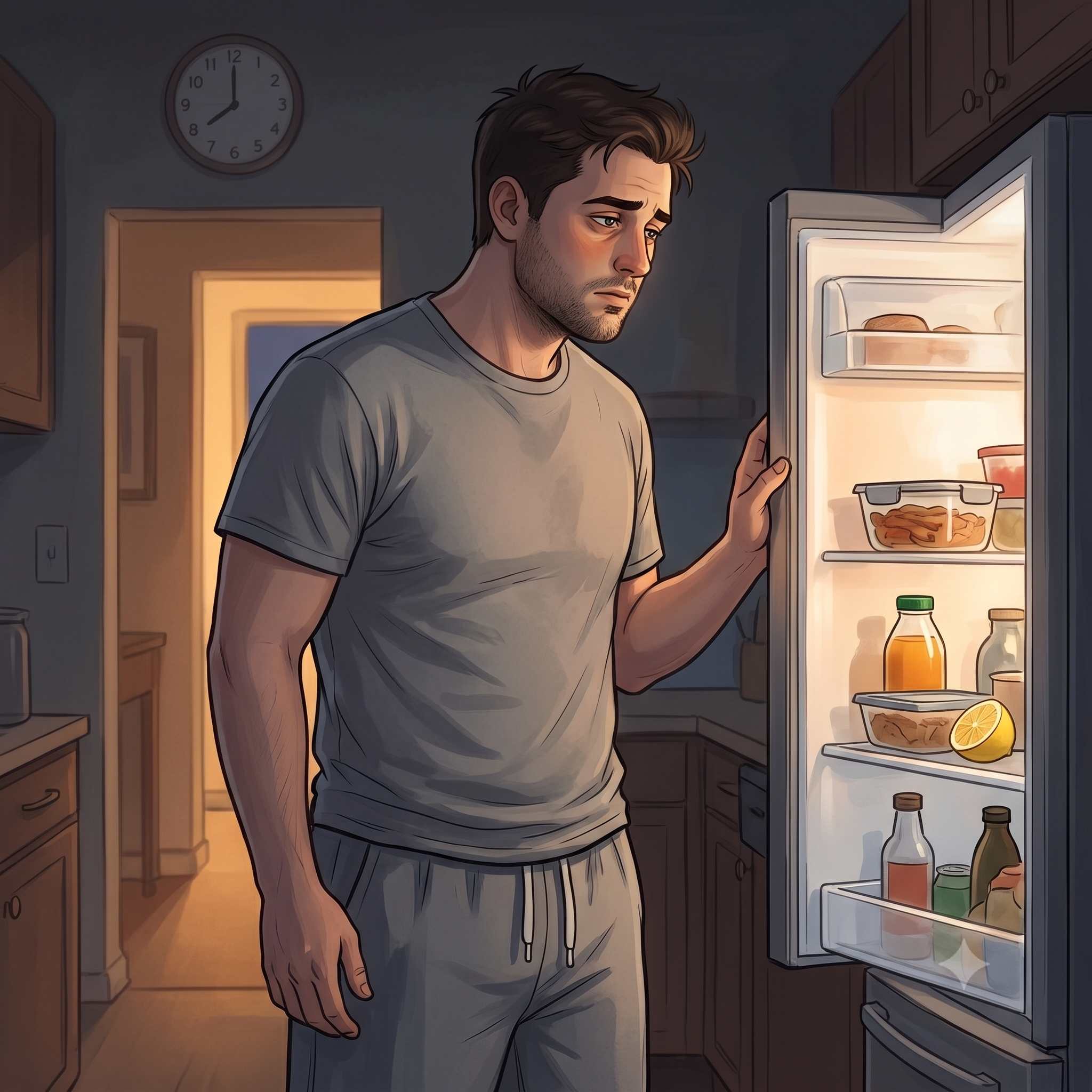
You eat brilliantly all day. A sensible breakfast, a balanced lunch, maybe a piece of fruit in the afternoon. And then 8pm arrives, you find yourself standing in front of the open fridge, and somehow half a packet of biscuits disappears before you've even decided to eat them. If your discipline seems to evaporate the moment the sun goes down, you're not broken — you're experiencing decision fatigue.
Decision fatigue is one of the most under-appreciated reasons people make poor food choices at night, and it explains why "just try harder" never works after dark. The good news: once you understand why your evening self is so unreliable, you can stop depending on it altogether. In this article we'll unpack the science, then show you how to automate your evenings so eating well no longer needs willpower at all.
What is decision fatigue?
Decision fatigue is the steady decline in the quality of your decisions after making many of them in a row. Every choice you make — what to wear, what to reply, which task to tackle — draws on the same limited pool of mental energy. As that pool empties, your brain starts taking shortcuts, avoiding effort, and defaulting to whatever is easiest in front of you.
One widely-cited field study of judges found that the share of favourable rulings dropped sharply across a long session and recovered again after a food break. Whatever the precise mechanism, the pattern is a useful illustration of the same everyday truth: judgment gets worse as choices accumulate, and a rest or a meal helps reset it. Your food decisions are no different.
Why do I make poor food choices at night specifically?
Night-time is the perfect storm because three separate forces converge just as your defences drop. Understanding them takes the shame out of the situation — this isn't a willpower failure, it's a predictable collision of psychology and biology.
1. Your self-control is running on empty
Self-control behaves like a resource that gets used up. Research has linked acts of self-control to the brain's available energy supply, and while the science here is nuanced, the lived experience is universal: resisting temptation feels far harder at 10pm than at 10am. By evening you've already spent your restraint on work, family and a hundred small decisions.
2. Your body clock turns up your appetite
Even with identical meals and sleep, your internal clock drives hunger higher in the evening. A tightly-controlled laboratory study found a natural circadian peak in appetite around 8pm — including cravings for sweet, salty and starchy foods. So that pull towards the biscuit tin isn't purely in your head; it's partly your physiology on schedule.
3. A tired brain wants fast fuel
When you're depleted and winding down, your brain looks for quick, reliable energy — and sugar and fat deliver exactly that. Combined with the day's stress and the comfort we attach to certain foods, the healthy option barely gets a look in. If you'd like the deeper hormonal picture behind these urges, our guide to hunger hormones and why you're always hungry goes further.
Key insight: Night-time cravings are the sum of depleted willpower, a rising appetite rhythm, and a tired brain seeking fast fuel. Fighting all three at once, at your weakest hour, is a battle you're set up to lose.
How do I stop making bad food choices at night? Automate your evenings
The answer isn't to summon more willpower after dark — it's to make the decision earlier in the day, while you still have the capacity, so your tired evening self simply follows a plan. This is the same logic behind building systems instead of relying on willpower: you remove the choice rather than win the fight. Here's how to put your evenings on autopilot.
Decide once, in the morning — not nightly
The single most powerful move is to pre-decide what your evening looks like. Portion out dinner and any snacks in advance, so at 9pm there's no open-ended question, just a ready meal or a measured snack waiting for you. Pre-portioning into reusable meal prep containers turns a tempting free-for-all into a single, effortless "grab and done" choice.
Design the environment so the easy choice is the healthy one
You reach for what you see. Keep crisps and sweets out of sight — in a high cupboard, or simply not in the house — and put the fruit bowl and pre-cut veg at eye level. You're not banning treats; you're adding friction to the poor choice and removing it from the good one, so the path of least resistance finally works in your favour.
Build a wind-down routine that isn't food
A lot of evening eating is really a search for comfort or a signal that the day is over. Give that need a different outlet: a shower, a chapter of a book, a short walk — or a warm drink. A caffeine-free bedtime herbal tea works especially well: it turns the evening craving into a calming, zero-decision ritual that signals the day is done, and often takes the edge off the urge to graze.
Front-load your important decisions
Beyond food, protect your evening willpower by handling demanding choices earlier. Lay out tomorrow's clothes, plan the next day's meals at lunchtime, and batch trivial decisions so fewer of them land after dark. The fewer choices you face at night, the more of your depleted reserve is left for the ones that matter.
Why automating beats "trying harder" at night
Trying harder asks the most of you at the exact moment you have the least to give. Automation flips that: it front-loads the effort to the part of the day when good decisions are cheap, then coasts on the plan when they're expensive. It's not about discipline — it's about design.
Consistency is what makes it stick. Tracking your evening routine helps you see the pattern forming and keeps you honest on the harder nights; a simple habit tracker journal gives you a visible streak worth protecting. If you'd rather have that accountability without the admin, Health Mentor AI is built to spot your patterns, flag the moments you tend to slip, and nudge your evening routine into place — so eating well becomes the default rather than a nightly negotiation. You can get the app to try it as it rolls out.
The bottom line: don't outfight decision fatigue — outsmart it
Your evening cravings aren't proof of weak character. They're the predictable result of a depleted brain, a rising appetite rhythm, and an environment full of easy temptations. Expecting willpower to win that fight, night after night, is the real mistake.
So stop relying on the most tired version of yourself. Decide once in the morning, shape your environment, and give the evening a routine that runs itself. When the choice is already made, decision fatigue has nothing left to work with.
Frequently Asked Questions
What is decision fatigue?
Decision fatigue is the decline in the quality of your decisions after a long run of choices. Every decision draws on your mental resources, so by the end of the day your capacity for self-control is depleted and you default to whatever is easiest. That is why healthy choices feel effortless in the morning and nearly impossible at night.
Why do I make poor food choices at night?
Three forces stack up in the evening: your self-control is depleted after a full day of decisions, your body clock naturally pushes appetite to a peak around 8pm, and a tired, under-fuelled brain craves quick energy from sugar and fat. It is not a character flaw. It is predictable biology meeting a busy day.
How do I stop eating badly at night?
Automate the decision so your tired evening self does not have to make it. Pre-portion dinner and snacks in advance, keep tempting foods out of sight, make the healthy option the default, and build a non-food wind-down routine. When the choice is already made, willpower becomes irrelevant.
Is night-time snacking really about willpower?
Mostly no. Willpower is a limited resource that runs low by evening, so relying on it at your weakest moment is a losing strategy. Systems that remove the decision entirely are far more reliable than trying harder, because they work even when your motivation and self-control are gone.
Scientific References
- Extraneous factors in judicial decisions - Proceedings of the National Academy of Sciences (PubMed)
- The Internal Circadian Clock Increases Hunger and Appetite in the Evening - Obesity (NIH)
- Self-control relies on glucose as a limited energy source - Journal of Personality and Social Psychology (PubMed)
Products Mentioned in This Article
These products were referenced throughout the article to support your evening-automation journey.
Reusable Meal Prep Containers
Pre-portion dinner and snacks earlier in the day so there's no open-ended decision at night. A ready, measured meal turns a tempting free-for-all into a single "grab and done" choice.
View on Amazon →Caffeine-Free Bedtime Herbal Tea
A warm, calming cup gives the evening wind-down a non-food ritual. It signals the day is done and often takes the edge off the urge to graze — no decision required.
View on Amazon →Habit Tracker Journal
Log your evening wind-down routine and watch the streak build. A visible record keeps you honest on the harder nights and turns a new routine into an automatic one.
View on Amazon →As an Amazon Associate, we earn from qualifying purchases. This comes at no additional cost to you.