
It's 6:40pm. You know exactly what a good dinner looks like — you've read the articles, you could recite the macros. But the chicken is frozen solid, the vegetables need washing and chopping, there's a pan in the sink, and the takeaway app is one thumb-press away. You are not short of knowledge. You are short of about fifteen minutes and a clear worktop.
This is the part of nutrition advice that usually gets skipped. We treat eating well as a knowledge problem or a discipline problem, when for most people, most evenings, it's an effort problem. And effort is a design variable. You can rearrange a kitchen so the good choice is the easy one — and once you do, you need far less willpower, because you're no longer fighting your own worktop every night.
Why does effort beat intention so reliably?
Because intention has to be summoned fresh every time, and effort is charged at the moment you're least able to pay it. By early evening you've been making decisions all day, and small barriers that would be trivial at 10am — finding a chopping board, defrosting something — become genuinely decisive at 7pm.
We covered the mechanism behind that in detail in why you cave to cravings at night. The practical conclusion is uncomfortable but freeing: if your plan requires you to be disciplined at the worst possible hour, the plan is badly designed. The fix isn't more resolve. It's shifting the work to a time when it's cheap, and removing steps so there's less work to shift.
Key insight: Every step between you and a food is a tax on eating it. Add steps to what you want less of, remove steps from what you want more of. That's the whole strategy.
Does moving food around your kitchen actually change what you eat?
The evidence says the physical arrangement of food genuinely shifts consumption, though the research base is broader on shops and canteens than on domestic kitchens. This category of intervention has a name — choice architecture — and it's been studied seriously enough to warrant systematic review.
A Cochrane review by Hollands and colleagues examined whether altering the availability of products — the range or amount of options — or their proximity, meaning the distance at which they're positioned, changed people's selection and consumption. The review found that these environmental changes do shift behaviour, which is why they've attracted so much public health interest. Distance is not a trivial variable; it's one of the few reliable ones.
For the home specifically, a survey of 4,942 US adults published in BMC Public Health examined eleven dimensions of the home food environment. Food placement — literally where things are kept — was among the factors most strongly associated with meeting fruit and vegetable intake guidelines, alongside meal preparation, shopping frequency and the variety of produce available. That's cross-sectional data and can't prove causation, but it points at the same lever from a different angle.
What about plate and package size?
This one has unusually strong evidence, and it's the piece of kitchen design most people already own and never think about. A Cochrane review pooling 61 studies and 6,711 participants concluded that people consistently consume more food and drink when offered larger-sized portions, packages or tableware than smaller versions.
The detail that matters most: the size of the effect didn't vary substantively by sex, BMI, susceptibility to hunger, or how much people consciously try to control their eating. In other words, being aware of it and being determined about it doesn't appear to protect you. The reviewers were more cautious about whether shrinking things at the small end works as well as shrinking at the large end — so this is a reason to stop serving from a big sharing bowl, not a licence to eat off saucers.
Applied at home, that means: serve from the hob rather than putting dishes on the table, decant multipacks into a bowl rather than eating from the bag, and check what size your "normal" dinner plate actually is. Plate sizes have drifted upward over decades, and yours may be doing quiet work against you.
The one thing worth optimising above all: cooking at home
If you only change one thing, make cooking dinner easier — it's the single behaviour with the clearest link to overall diet quality. Analysis of 8,668 US adults from NHANES, published in Public Health Nutrition, found that households cooking dinner seven or more times a week scored about 3.6 points higher on the Healthy Eating Index-2015 than those cooking twice a week or less.
Worth being honest about the size of that: the HEI runs on a 100-point scale, so a few points is a real but modest improvement, and the association was stronger among higher-income adults — time, money and access all interact here. Earlier work by Wolfson and Bleich found frequent home cooks consumed less fat and sugar, and notably ate more moderately on the occasions they did eat out.
The reframe: don't try to become someone who loves cooking. Try to make cooking take twelve minutes instead of forty. Those are entirely different projects, and only one of them is achievable on a Tuesday.
🧱 High-friction kitchen
Cluttered worktop. Chicken frozen in a block. Vegetables whole in the salad drawer under something. Biscuits in a jar at eye level. Two clean pans, both in the dishwasher. Estimated effort to a good dinner: 40 minutes and a decision.
🛝 Low-friction kitchen
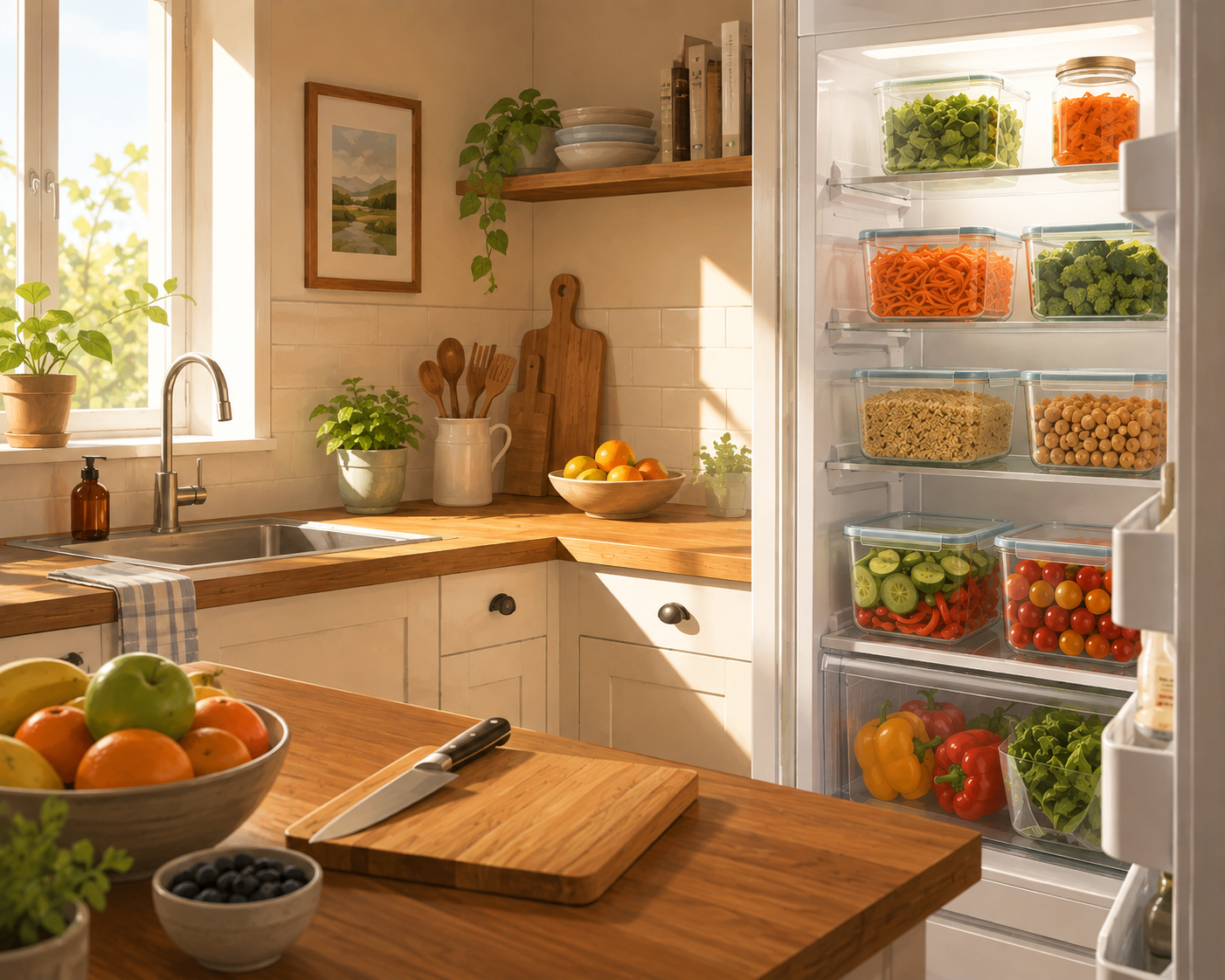
Clear worktop. Protein portioned and defrosting since morning. Veg washed and chopped in clear boxes at eye level. Biscuits in an opaque tin on a high shelf. Estimated effort: 12 minutes and no decision at all.
How do you actually redesign the kitchen?
The organising principle is that visibility and reach should match your intentions, not your habits. Here's where things belong once you accept that.
📍 Where things go
- Eye-level fridgePrepped veg, fruit, yoghurt, leftovers — the shelf you see first, every time
- Clear containersAnything you want eaten — if you can't see it, it rots and you order in
- WorktopFruit bowl, chopping board, kettle — and nothing else, ideally
- Opaque + highBiscuits, crisps, chocolate — not banned, just three steps further away
- Freezer frontPortioned protein, frozen veg — frozen veg is nutritionally fine and never wasted
- BinThe wilted bag of spinach — guilt about waste keeps bad systems alive
And the practical moves, roughly in order of return on effort:
- Clear the worktop. A clear surface is the difference between "I'll cook" and "I'll cook once I've dealt with all this". It costs nothing and it's the highest-leverage thing on this list.
- Prep once, eat five times. You don't need full meal prep. Washing and chopping vegetables on a Sunday, and portioning protein into containers, removes the exact steps that kill weeknight cooking. Glass boxes like PrepNaturals Glass Meal Prep Containers work here because they're transparent, oven-safe and stack — you see the food, and it goes fridge to oven without decanting.
- Give the fridge zones. An unzoned fridge hides food until it's off. Clear stackable bins such as mDesign Clear Storage Bins let you pull out a whole zone at once and mean nothing gets lost at the back.
- Add friction deliberately, don't ban. Prohibition tends to backfire and breeds the all-or-nothing thinking we wrote about in why you keep starting over every Monday. Keep the treats — just put them somewhere that requires a chair.
- Standardise a handful of default meals. Three or four meals you can make without thinking, whose ingredients you always keep, removes the "what shall we have?" negotiation that ends in a delivery app.
- Calibrate portions once. A kitchen scale like the Etekcity Digital Kitchen Scale isn't for weighing everything forever. Use it for a week to learn what 150g of chicken or 40g of oats actually looks like, then put it away and eyeball it. Given how strongly serving size drives intake, that one week of calibration is worth a lot.
- Shop to the system. Buy the vegetables you'll actually prep on Sunday, not the ones you aspire to. And a shopping list built around your default meals is much cheaper — worth reading alongside protein on a budget.
What if you share a kitchen?
Most of this survives a shared household, because you're changing placement rather than removing anyone's food. Nobody has to agree to a diet for the fruit bowl to be on the counter and the crisps to be in a cupboard. The negotiation is about geography, not permission, and that's a much easier conversation.
Where it gets harder is portion serving and takeaway habits, which are genuinely joint decisions. Worth knowing that the survey of the home food environment also linked eating in front of the television, and having a TV in the dining area, with worse dietary outcomes. If you want one shared change to propose, that's a good candidate — and it's about where you eat rather than what, which tends to land better.
Make it stick: measure friction, not just food
A kitchen redesign fails the same way a gym membership does — it works for two weeks, then entropy wins. The counter fills up, the prepped veg doesn't get replaced, and by week four you're back to the takeaway app wondering what happened.
What helps is treating the system itself as the thing you track, not just the eating. Did the Sunday prep happen? Is the counter clear? Are there three default meals' worth of ingredients in? Those are binary, honest questions, and they predict next week's eating far better than any individual meal does. This is where a tool like Health Mentor AI earns its place — logging what you actually ate alongside what was going on in your week, so you can see which weeks fell apart and, more usefully, why.
The underlying idea is one we keep coming back to: the people who eat well consistently mostly aren't exercising more self-control than you. They've arranged things so less is required. Their kitchen is doing the work, quietly, every evening — which is exactly the argument we made about training in stop relying on willpower. Build the system once; let it pay you back nightly.
Frequently Asked Questions
Does moving unhealthy food out of sight actually work?
The principle is supported by evidence. A Cochrane review of altering the availability and proximity of food found that changing how close products are to people, and how many options are offered, changes what they select and consume. A national survey of nearly 5,000 US adults also found food placement in the home was among the factors most strongly associated with meeting fruit and vegetable guidelines.
Do smaller plates really reduce how much you eat?
A Cochrane review pooling 61 studies and 6,711 participants found people consistently consume more when offered larger portions, packages or tableware. The effect did not vary substantially by sex, BMI, hunger or dietary restraint. It is less certain whether reductions at the smaller end of the size range work as well as reductions at the larger end.
Is cooking at home actually linked to a better diet?
Yes, consistently. Analysis of over 8,600 US adults found that cooking dinner seven or more times a week was associated with a Healthy Eating Index score around 3.6 points higher than cooking twice a week or less. The improvements are real but modest, and the effect was stronger among higher-income adults.
Where should you start if your kitchen is a mess?
Start with the eye-level shelf of your fridge and the kitchen counter, because those two surfaces drive the most unplanned eating. Move the food you want to eat more of into them, and move everything else into opaque containers or higher shelves. That single hour of rearranging costs nothing and changes every subsequent decision.
Scientific References
- Hollands et al. (2019), Cochrane Database of Systematic Reviews — Altering the availability or proximity of food, alcohol, and tobacco products to change their selection and consumption
- Hollands et al. (2015), Cochrane Database of Systematic Reviews — Portion, package or tableware size for changing selection and consumption of food, alcohol and tobacco
- BMC Public Health (2021) — Home food environment and associations with weight and diet among U.S. adults
- Wolfson, Leung & Richardson (2020), Public Health Nutrition — More frequent cooking at home is associated with higher Healthy Eating Index-2015 score
- Wolfson & Bleich (2015), Public Health Nutrition — Is cooking at home associated with better diet quality or weight-loss intention?
Products Mentioned in This Article
These products were referenced throughout the article to help you remove friction from your kitchen.
PrepNaturals Glass Meal Prep Containers
Transparent so you can actually see what you prepped, oven and microwave safe so food goes straight from fridge to heat without decanting, and stackable so a Sunday prep session fits in a normal fridge. Glass also doesn't stain or hold odours the way plastic does.
View on Amazon →mDesign Clear Stackable Storage Bins
Turns a chaotic fridge or cupboard into zones you can pull out whole. The point isn't tidiness for its own sake — it's that food you can see gets eaten, and food lost at the back gets thrown away and replaced with a takeaway.
View on Amazon →Etekcity Digital Kitchen Scale
Inexpensive, thin enough to live in a drawer, with a tare function so you can weigh straight into a bowl. Use it for a week to calibrate what standard portions look like, then rely on your eye — given how strongly serving size drives intake, that week is a genuinely high-return investment.
View on Amazon →As an Amazon Associate, we earn from qualifying purchases. This comes at no additional cost to you.