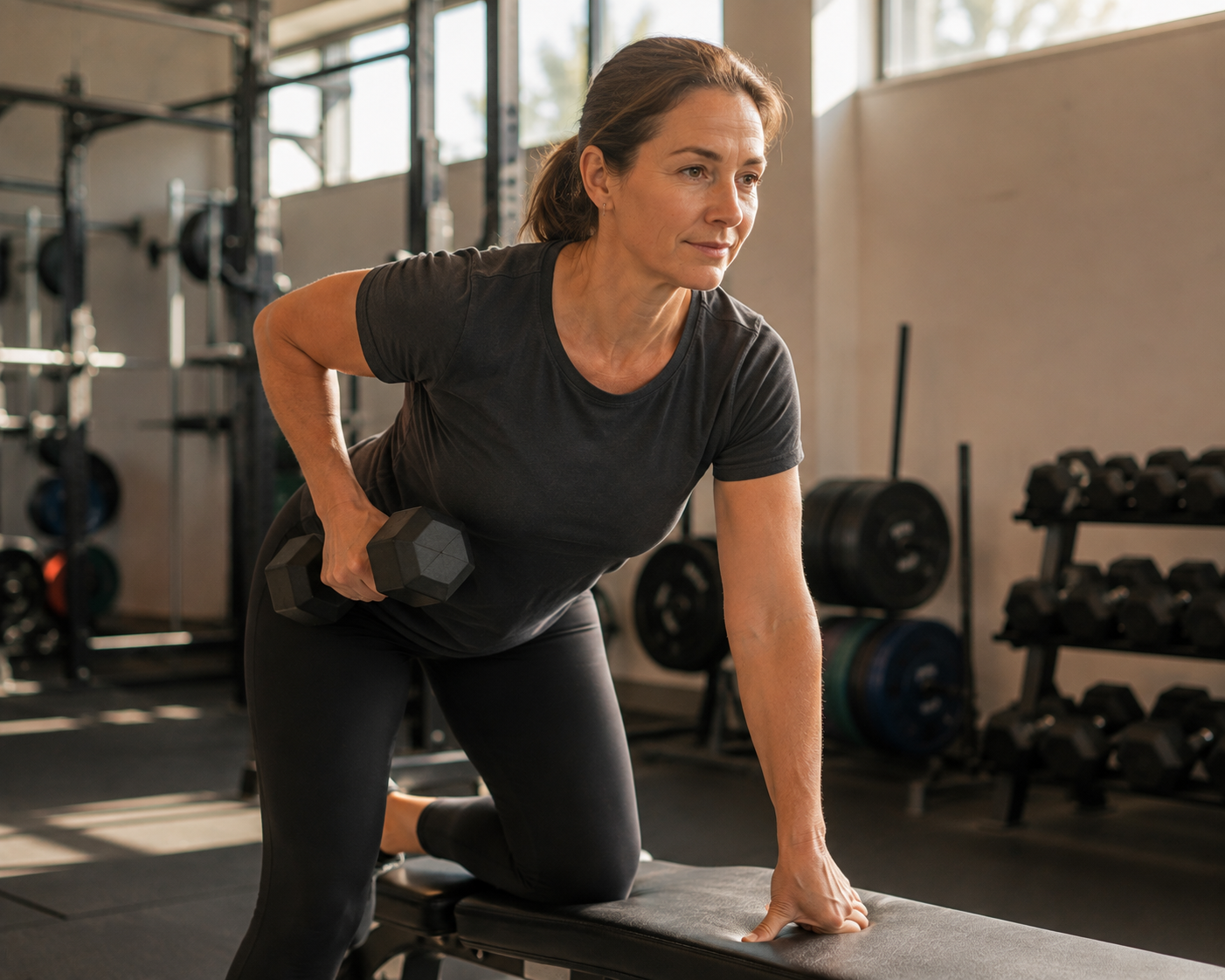
There's a specific kind of guilt that arrives around the 14th of the month, when the direct debit goes out for a gym you last visited in March. It's a common enough experience that economists have measured it. In a study of 7,752 members across three US health clubs, people on flat monthly contracts over $70 forecast that they'd attend around 9.5 times a month. Their actual average was closer to 4.3 — a price of more than $17 per visit, when a ten-visit pass would have cost them $10 a session.
That gap isn't a character flaw. It's a friction problem: the drive, the parking, the changing room, the twenty minutes you don't have on a Tuesday. And it raises a question worth answering properly rather than sloganeering about — if you removed the building entirely and trained with your own body in the room you're standing in, what exactly would you lose? The research on this is better than most people assume, and the honest answer is: less than you think, but not nothing.
Can you actually build muscle without weights?
Yes — and the mechanism explains why. Muscle grows in response to high mechanical tension in a fibre, sustained close to the point of failure. The fibre has no way of knowing whether that tension comes from a loaded barbell or from your own torso suspended between your hands and toes. What it registers is force, time and effort.
The clearest evidence comes from load-comparison research. A systematic review and meta-analysis of 21 trials published in the Journal of Strength and Conditioning Research compared light loads (60% of one-rep max or below) with heavy loads, in protocols where every set went to momentary muscular failure. Changes in muscle size were similar between the two conditions. Gains in one-rep-max strength significantly favoured the heavy loads. The authors' summary is worth remembering: maximal strength comes from heavy loads, but hypertrophy can be achieved across a wide spectrum of loading.
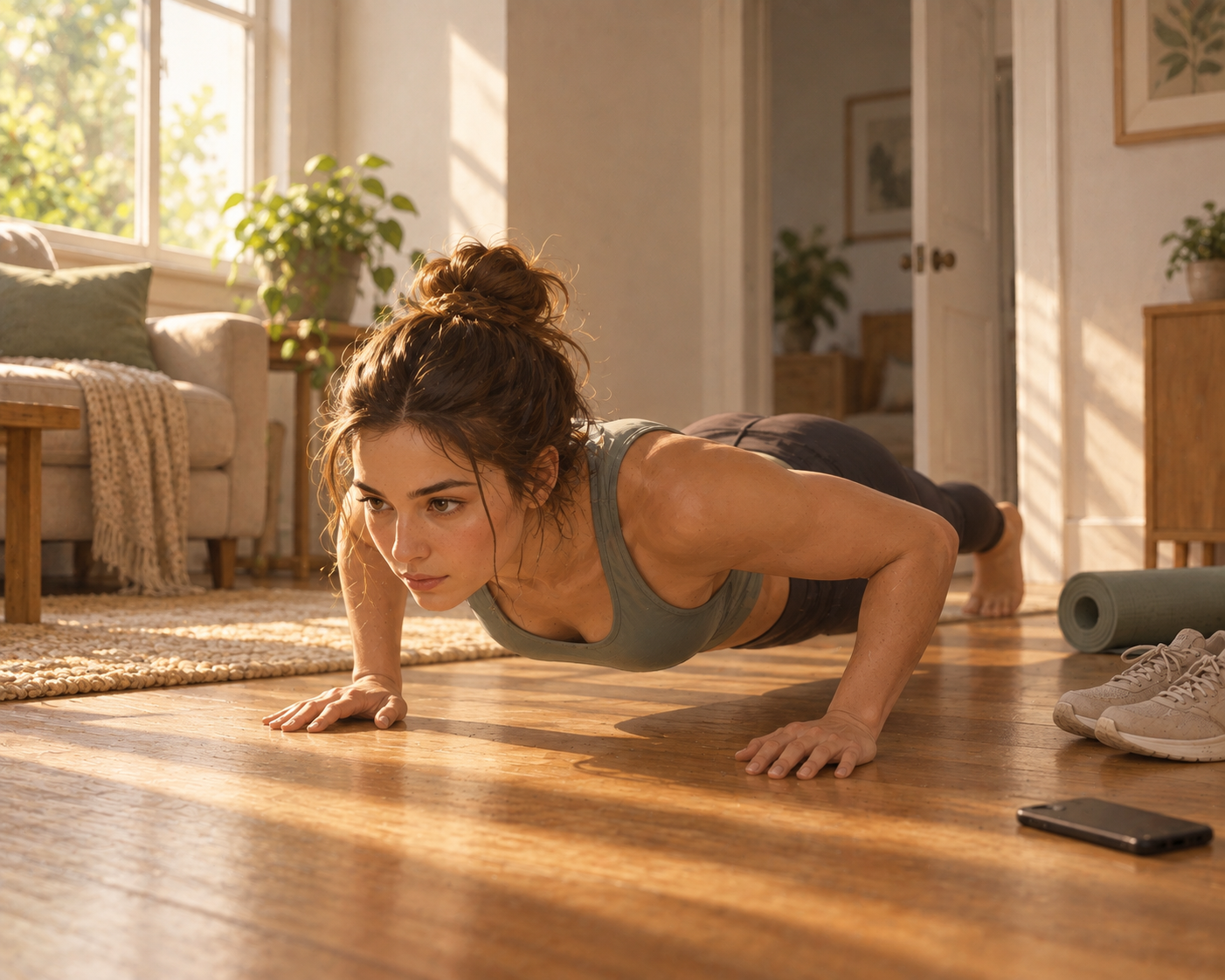
Then there's the direct test. Kikuchi and Nakazato randomised 18 men to eight weeks of either bench pressing at 40% of one-rep max or push-ups adjusted (kneeling, hands elevated) to the same relative load, both to failure, twice weekly. Reported in the Journal of Exercise Science & Fitness, both groups significantly increased pectoralis major and triceps thickness, and both increased their bench press one-rep max. The only divergence was biceps thickness, which grew only in the bench press group.
Key insight: The muscle responds to tension and effort, not to equipment. A set of push-ups taken to two reps from failure is a genuine hypertrophy stimulus. A set of bench presses done comfortably is not.
Is a push-up really comparable to a bench press?
For building the pressing muscles, the evidence says closer than the weights room would like. A four-week trial published in the Journal of Strength and Conditioning Research took 23 moderately trained men and assigned them either progressive calisthenic push-up training or traditional bench press training, three days a week. Crucially, the push-up group didn't just repeat the same push-up — they moved through a ladder of nine variations as each became manageable. Both groups increased strength and muscle thickness comparably.
That word progressive is doing the heavy lifting. The reason bodyweight training has a reputation for stalling isn't that bodyweight is inadequate — it's that most people never build the ladder. They do 20 push-ups in week one, 20 in week ten, and correctly conclude that nothing is happening.
The other reason to take push-ups seriously is what they predict. A Harvard-affiliated study followed 1,104 active male firefighters for a decade. Men who could complete more than 40 consecutive push-ups at baseline had a 96% lower rate of cardiovascular events over the following ten years than those managing fewer than 10 — and push-up capacity was more strongly associated with cardiovascular risk than a submaximal treadmill test. It's an observational finding in a specific, physically active population, so it doesn't prove that doing push-ups prevents heart disease. But it's a striking association for a movement that requires a floor.
What are the honest limits of bodyweight training?
There are two, and they're worth stating plainly rather than glossing over. The first is maximal strength: if your goal is a bigger one-rep max, heavy external load is genuinely superior, and no amount of push-up variation replaces it. The second is that some movement patterns are awkward to load with body weight alone.
- Vertical pulling. There is no bodyweight substitute for hanging. You can approximate rows under a sturdy table, but a bar or set of rings is the one piece of kit that meaningfully expands what's possible. This is the purchase to make.
- Heavy hinging. Deadlift and hip-thrust patterns are hard to overload without weight. Single-leg Romanian deadlifts, hip thrusts with a long pause, and slow eccentric Nordic curls get you a long way, but this is where bodyweight training works hardest for its results.
- Two-legged squats. A bodyweight squat stops being challenging fast. The answer isn't more reps — it's split squats, Bulgarian split squats, step-ups and eventually pistol progressions, which put most of your mass over one leg.
Notice that none of these is a reason to skip resistance training. They're reasons to choose exercise variations deliberately. If you're weighing this against a return to the weights room, our piece on what resistance training actually does to body composition and bone density covers the other side of the argument.
How do you progressively overload without adding weight?
You change the leverage instead of the load. Progressive overload means the demand on the muscle increases over time; adding kilos is only the most obvious way to do that. There are six levers available to you in an empty room, and using them deliberately is the entire difference between bodyweight training that works and bodyweight training that plateaus in month two.
🪜 The six levers of bodyweight overload
- Leverage. Move the movement up the ladder — hands elevated on a counter, then a chair, then the floor, then feet elevated, then archer, then one-arm. Same exercise, more of your mass on less of you.
- Range of motion. Deeper split squats, push-ups with your chest to the floor, dips to a full stretch. More range means more time under tension in the lengthened position, which is where most growth happens.
- Tempo. A three-second lowering phase turns an easy set into a hard one without changing anything else. Pauses at the bottom remove the bounce you've been borrowing.
- Unilateral work. One limb doing what two were doing roughly doubles the load. This is the primary progression route for legs.
- Density. Same work, less rest. Drop from 90 seconds between sets to 45 and the session gets harder while the exercises stay identical.
- Proximity to failure. The lever most people ignore. Light loads only match heavy ones when the sets go close to failure — stopping at "that was enough" is where results quietly disappear.
The practical rule: change one lever at a time, and only when the current version is comfortable for the top of your rep range with two reps left in reserve. If you can do 15 clean push-ups with something left, elevate your feet — don't chase 25.
What does a week actually look like?
Three sessions of 25–35 minutes covers it. Each session is 4–5 movements, 3 sets each, taken to within two or three reps of failure. Full-body sessions three times a week beat a body-part split here, because you're rotating patterns rather than muscles.
Session A — Push focus
- Push-up variation — 3 sets
- Split squat — 3 sets per leg
- Inverted row or ring row — 3 sets
- Pike push-up (shoulders) — 3 sets
- Hollow-body hold — 3 sets
Session B — Pull focus
- Pull-up or band-assisted pull-up — 3 sets
- Single-leg Romanian deadlift — 3 sets per leg
- Dips or bench dips — 3 sets
- Glute bridge, paused — 3 sets
- Side plank — 3 sets per side
Session C — Legs & core
- Step-up or Bulgarian split squat — 3 sets
- Slow eccentric Nordic curl — 3 sets
- Push-up, one level easier, slow tempo — 3 sets
- Calf raise, single leg — 3 sets
- Dead bug — 3 sets
Three sessions, no commute, no queue for the squat rack. And if three sessions feels like a stretch to commit to, the honest starting point is smaller than that — the argument for beginning at an almost embarrassingly low bar is laid out in the 3-minute rule.
How do you know it's working without a number on the bar?
This is the real disadvantage of training without weights, and it's a measurement problem rather than a physiological one. A barbell tells you your progress in kilos. Bodyweight training gives you the same information, but scattered across variation, reps, tempo and rest — so it's easy to improve substantially and never notice.
The fix is to write down four things per exercise: the variation, the reps, the tempo and the rest. Over eight weeks the pattern you want is visible immediately — moving from knee push-ups at 12 reps to full push-ups at 12 reps is a large strength gain that a rep count alone would show as no change at all. This is exactly the sort of multi-variable trend Health Mentor AI is built to surface, connecting what you trained to how you slept, ate and recovered across months rather than leaving you to remember week three.
A second useful marker: retest a benchmark every eight weeks. Maximum push-ups, maximum pull-ups or assisted pull-ups, and a timed wall sit. Three numbers, ten minutes, and an unambiguous answer.
What kit is actually worth buying?
Almost nothing, and then one or two things. The budget for a year of bodyweight training is comfortably less than two months of a $100 membership, and the items that earn their place are the ones that solve the pulling problem or extend your progression ladder.
- Something to hang from. A doorway bar like the Perfect Fitness Multi-Gym Pro unlocks pull-ups, chin-ups and hanging core work, and flips over for dips and elevated push-ups. If your back is going to be trained at all, this is the purchase.
- Resistance bands. A set such as the Fit Simplify Resistance Loop Bands gives you assisted pull-ups when you can't yet do one, and added resistance on hip and shoulder work when body weight alone is too light.
- Rings, eventually. A set of wooden gymnastic rings is the single biggest expansion of a bodyweight ladder — row height is infinitely adjustable, and ring push-ups, dips and rows are all considerably harder than their fixed equivalents.
Skip the rest until you've trained consistently for three months. The equipment people buy in January is rarely the reason they're still training in June — the systems are, and those are worth designing deliberately.
How long before you see anything?
Around eight weeks for measurable change, longer for visible change. In an 8-week calisthenics trial published in Isokinetics and Exercise Science, untrained men following a structured bodyweight protocol improved push-up performance by roughly 16% and pull-up performance by roughly 39%, with a significant reduction in fat mass, against a control group that didn't change. The Kikuchi push-up group added measurable chest and triceps thickness in the same timeframe.
Which sets a reasonable expectation: the first four weeks feel like coordination improving rather than muscle appearing, because that's largely what's happening. Somewhere in weeks six to twelve the ladder starts moving — you find you're doing the variation that felt impossible in week one. That's the point at which most people stop wondering whether it counts.
The membership was never the thing that made you strong. Turning up on a Tuesday, close enough to failure to matter, for long enough for it to add up — that was always the thing. It just happens to be free.
Frequently Asked Questions
Can you build real muscle with only bodyweight exercises?
Yes. A meta-analysis of 21 trials found that when sets are taken close to failure, muscle growth is similar whether the load is light or heavy. In one 8-week randomised trial, push-ups produced comparable increases in chest and triceps thickness to bench pressing at a matched load. Effort and proximity to failure matter more than the source of the resistance.
Is bodyweight training as good as lifting weights for strength?
For muscle size, close to it. For maximal one-rep-max strength, heavy loads have the edge — the same meta-analysis found significantly greater 1RM gains with high loads. If your goal is to look and feel strong, bodyweight training is enough. If your goal is to lift the heaviest possible barbell, you will eventually need a barbell.
How do you progressively overload without adding weight?
By changing leverage rather than load. The six levers are: harder variations (incline to flat to feet-elevated to one-arm), longer range of motion, slower tempo, single-limb versions, shorter rest between sets, and training closer to failure. A progressive push-up programme built pressing strength comparable to bench press training in one four-week trial.
What is the hardest thing to train without a gym?
Pulling and heavy lower-body work. Vertical pulling needs something to hang from, which is why a doorway bar or rings is the one purchase worth making. Legs are trainable but need unilateral variations — split squats, step-ups, single-leg hinges — because two-legged bodyweight squats stop being challenging quickly.
How long does it take to see results from bodyweight training?
Measurable changes typically appear in about 8 weeks of consistent training. In an 8-week calisthenics trial in untrained men, push-up performance improved by around 16 percent, pull-ups by around 39 percent, and fat mass fell significantly. Visible change usually lags performance change by several weeks.
Scientific References
- Schoenfeld et al. (2017), Journal of Strength and Conditioning Research — Strength and hypertrophy adaptations between low- vs. high-load resistance training: a systematic review and meta-analysis
- Kikuchi & Nakazato (2017), Journal of Exercise Science & Fitness — Low-load bench press and push-up induce similar muscle hypertrophy and strength gain
- Kotarsky et al. (2018), Journal of Strength and Conditioning Research — Effect of progressive calisthenic push-up training on muscle strength and thickness
- Yang et al. (2019), JAMA Network Open — Association between push-up exercise capacity and future cardiovascular events among active adult men
- DellaVigna & Malmendier (2006), American Economic Review — Paying Not to Go to the Gym
- Thomas et al. (2017), Isokinetics and Exercise Science — The effects of a calisthenics training intervention on posture, strength and body composition
Products Mentioned in This Article
These products were referenced throughout the article to support building and progressing a bodyweight training routine at home.
Perfect Fitness Multi-Gym Doorway Pull Up Bar (Pro)
Solves the one genuine gap in bodyweight training — vertical pulling. Fits door frames up to 33 inches, three grip positions, and flips over onto the floor for dips, push-ups and sit-ups. 300lb capacity.
View on Amazon →Fit Simplify Resistance Loop Exercise Bands (Set of 5)
Five resistance levels for a few pounds. Useful in both directions — assistance for pull-ups you can't yet do unassisted, and added resistance for hip and shoulder work where body weight alone is too light.
View on Amazon →Wooden Gymnastic Rings with Adjustable Straps
The biggest single expansion of a bodyweight progression ladder. Infinitely adjustable row height means you can dial difficulty precisely, and ring push-ups, dips and rows are meaningfully harder than their fixed equivalents.
View on Amazon →As an Amazon Associate, we earn from qualifying purchases. This comes at no additional cost to you.