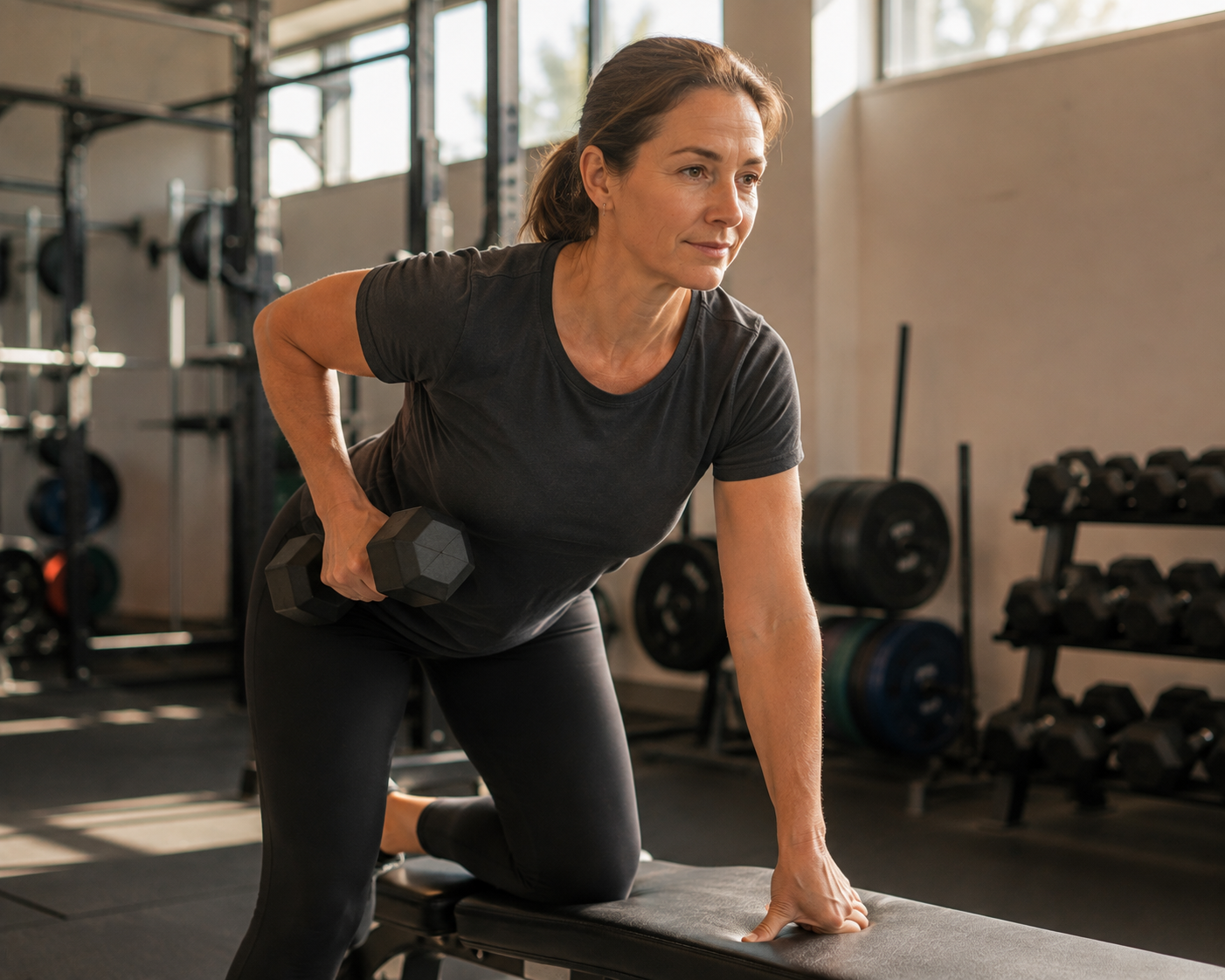
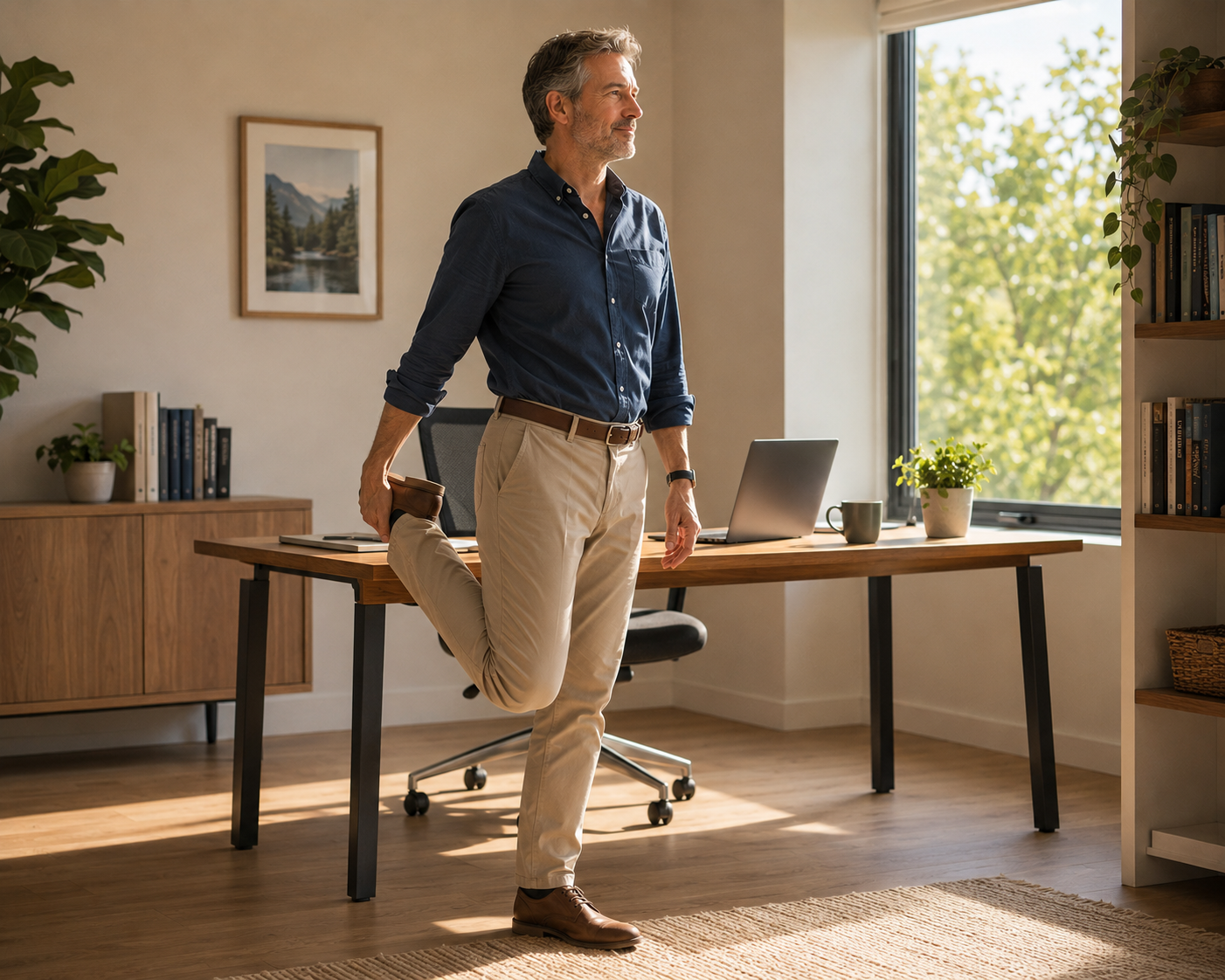
You train four times a week. You take the stairs. And yet by Thursday afternoon your lower back is grumbling, your hips feel welded shut, and getting out of the car takes a small negotiation. This is the specific frustration of the desk-bound athlete: doing the exercise, still carrying the damage.
The reason is that a training session and a working day are separate exposures. One hour of deliberate effort doesn't neutralise eight hours of a fixed position, any more than a salad neutralises a week of takeaways. Both count. Below is what the research actually shows about that eight hours — including a couple of widely repeated claims that don't hold up — and a protocol that fits into a real working day.
How much exercise does it take to offset sitting all day?
More than most of us do, but the number is knowable. A harmonised meta-analysis of data from more than one million men and women, published in The Lancet, examined exactly this. The finding: high levels of moderate-intensity physical activity — around 60 to 75 minutes per day — appeared to eliminate the increased risk of death associated with high sitting time.
Two things follow from that. First, this is genuinely reassuring: the harm from sitting isn't fixed and unavoidable, and it responds to activity. Second, 60–75 minutes a day is roughly double the standard public health recommendation and far beyond what most people with desk jobs achieve. If you're doing three or four gym sessions a week, you're at a fraction of that dose.
The same analysis found something more awkward about television: high activity attenuated but did not eliminate the risk associated with prolonged TV viewing. Which suggests it isn't purely the sitting posture that matters, but what accompanies it — and that the evening you spend recovering from the day at a desk is part of the same total.
🗓️ The weekend-warrior pattern
Nine hours seated on weekdays, broken only by lunch. Two hard gym sessions and a long weekend run. Big total activity, but five days of near-uninterrupted sitting either side of it.
🚶 The distributed pattern
Same training, plus a two-minute walk every half hour, a genuine lunch walk, and standing calls. The training total barely changes — the seated total drops by two hours and the breaks number in dozens.
Why do short breaks work when a long workout doesn't fully compensate?
Because muscle contraction has immediate, local effects on how your body handles the food you've just eaten, and those effects don't wait for the evening. This is where the evidence gets unusually practical.
In a randomised crossover trial published in Diabetes Care, 19 overweight adults aged 45–65 completed three conditions: five hours of uninterrupted sitting, or the same five hours broken by two-minute bouts of light-intensity walking every 20 minutes, or by two-minute bouts of moderate walking. Both activity-break conditions significantly reduced the glucose and insulin responses to a test meal compared with uninterrupted sitting.
Note what that means. Two minutes. Light intensity. Not a workout — a stroll to the kettle, done regularly. And light walking was about as effective as moderate walking, which means the barrier to entry here is essentially zero.
Key insight: The metabolic benefit tracked the frequency of interruptions more than their intensity. You cannot bank this at 6pm — it has to happen during the sitting.
So does a standing desk solve it?
Less than the marketing implies, and this is the finding most likely to change what you buy. A randomised crossover study in the Journal of Science and Medicine in Sport compared uninterrupted sitting, sitting broken up by light-intensity walking, and sitting broken up by standing. Walking breaks improved postprandial blood glucose. Standing breaks did not.
Standing isn't worthless — it changes hip and spine position, unloads the tissues that have been compressed, and makes it far more likely you'll actually move. But swapping a chair for a standing desk and then remaining motionless for three hours is a different intervention from the one the metabolic research supports. A standing desk is a tool for changing position frequently, not a substitute for contraction.
Worth adding: standing all day has its own costs, including lower limb discomfort and swelling. The target isn't standing. It's variety.
What does sitting actually do to your hips?
It's associated with a measurable loss of hip extension range, which is the change with the best evidence behind it. Researchers used the modified Thomas Test to assess passive hip extension across 144 individuals, alongside sitting and activity questionnaires, in a study published in Musculoskeletal Science and Practice. People with low activity who sat more than seven hours daily had approximately 6° less passive hip extension than active people sitting under four hours.
The mechanism proposed is straightforward: sitting holds the hip at around 90° of flexion for hours, placing the hip flexors in a shortened position, and muscle adapts to the position it habitually occupies. The authors were careful to note this is cross-sectional — it demonstrates an association and suggests physiological adaptation, but doesn't prove sitting caused it, and whether it drives musculoskeletal pain still needs research.
Six degrees sounds trivial. It isn't, if you run: hip extension is where propulsion comes from, and a range you don't have gets borrowed from the lower back instead.
The bit everyone gets wrong: your glutes aren't "switched off"
You'll have seen the claim that sitting causes "gluteal amnesia" or "dead butt syndrome" — that tight hip flexors reciprocally inhibit the glutes and switch them off. It's repeated constantly, and the evidence for it is much thinner than its popularity suggests.
The reciprocal-inhibition logic doesn't survive scrutiny: tight muscles aren't generally more active, especially at rest or when shortened, so the proposed mechanism for switching the glutes off is shaky. And in a squat, the hip flexors are slack — gravity flexes your hips, not your psoas — so a "tight" hip flexor isn't plausibly interfering with gluteal work in the way the story requires.
Why does this matter practically? Because it changes the prescription. If your glutes were neurologically switched off, you'd need activation drills — clamshells and glute bridges before every session to "wake them up". If the actual issue is a stiffer anterior hip and less available range, then the answer is loading the hips through full range and reclaiming extension, which is a training problem, not a neurological one. The second is a better use of your time.
What about posture and your neck?
Be sceptical of the posture panic. The relationship between "bad" posture and pain is far weaker and messier than the diagrams of slumped office workers suggest, and plenty of people with textbook-poor posture have no pain at all while plenty with perfect alignment do.
The more defensible framing is that the problem is static loading rather than any particular position. Tissues tolerate load; what they tolerate poorly is the same load, unchanged, for hours. On that view, the best posture really is the next one, and the fix isn't sitting up straighter — it's not sitting still. That reframe tends to be a relief for people who've spent years being told their spine is wrong.
The desk-bound athlete's protocol
Two components: frequent low-effort interruptions through the day, and a small amount of targeted work that specifically opposes the position you spend the day in.
⏱️ Through the working day
- Every ~30minStand and walk for 1–2 minutes — this is the highest-value item on the list
- Mid-morning30 seconds of standing hip extension — squeeze glute, drive leg back, don't arch the back
- LunchA real 10–15 minute walk, outdoors — doubles as daylight for your body clock
- Mid-afternoon10 slow chair sit-to-stands — contraction without leaving your desk
- CallsTake them standing or walking — the easiest habit to attach movement to
Then, two or three times a week, ten minutes that directly opposes the seated position:
- Reclaim hip extension. Half-kneeling hip flexor stretch with the glute actively squeezed, 30–45 seconds each side. Combining the stretch with a contraction beats passive hanging about in the position.
- Load the hips through range. Split squats, Romanian deadlifts, hip thrusts and step-ups train the pattern your desk removes. If you only have time for one, split squats — they demand extension on one side while loading the other.
- Train the upper back. Rows, face pulls and any horizontal pulling counteract hours of reaching forward towards a keyboard. Not because your posture is broken, but because that musculature simply doesn't get used at a desk.
- Roll the tissue that's been compressed. Foam rolling the quads, glutes and upper back before mobility work makes the range easier to access in the moment. Something like the TriggerPoint GRID Foam Roller is the standard tool. Treat it as short-term relief that makes the strength work easier, not as the fix itself.
On equipment: the highest-return purchase for a desk worker is anything that converts sitting time into walking time. An under-desk unit like the Sperax Walking Pad does that directly, and walking at 2mph while answering email is exactly the light-intensity movement the Dunstan trial used. If a treadmill is impractical, a converter such as the VIVO Height Adjustable Standing Desk Converter at least lets you change position on demand — just don't expect standing alone to do the metabolic work.
If your existing knee or back discomfort is the thing driving all this, our guides to the common causes of knee pain during workouts and loading joints that already hurt are worth reading alongside this.
Making it survive a busy week
The reason this fails isn't difficulty — it's that a two-minute walk is precisely the sort of thing that vanishes the moment work gets busy, and you never notice it going. Nobody skips a gym session without registering it. Everybody skips forty movement breaks without noticing a single one.
So attach the breaks to things that already happen: every meeting ending, every coffee, every time you finish a task. And track the pattern rather than the intention — logging your daily steps and seated hours alongside how your back and hips actually feel over a month is where the relationship becomes visible. That's what Health Mentor AI is designed for: connecting the boring inputs to the outcomes you care about, over a long enough window to see it. Building the trigger rather than relying on remembering is the same principle we set out in stop relying on willpower.
The reframe worth keeping: you're not trying to earn back your working day with one heroic hour. You're trying to make the day itself less of a single, uninterrupted exposure. Sixteen small interruptions beat one large correction — and unlike the correction, they're available on the days you're too busy to train.
Frequently Asked Questions
How much exercise offsets sitting all day?
A harmonised meta-analysis of over one million adults found that around 60 to 75 minutes of moderate-intensity activity per day appeared to eliminate the increased mortality risk associated with high sitting time. That is considerably more than most people do, and more than standard guidelines require, though any activity helps and the risk falls progressively.
Does a standing desk fix the problems caused by sitting?
Only partly. In a randomised crossover trial, breaking up sitting with light-intensity walking improved postprandial blood glucose, but breaking it up with standing did not. Standing changes your position and unloads the hips, which has value, but it does not appear to deliver the metabolic benefit that movement does.
Does sitting really cause tight hip flexors?
There is evidence for reduced hip extension. A study of 144 people found that those who were inactive and sat more than seven hours a day had around 6 degrees less passive hip extension than active people who sat less than four hours. It is cross-sectional data, so it shows an association rather than proving sitting caused it.
How often should you get up from your desk?
Trials showing metabolic benefit have typically used short activity breaks every 20 to 30 minutes — as little as two minutes of light walking. A practical target is standing and moving briefly at least twice an hour, with a longer walk at lunch. Frequency of breaks appears to matter more than their intensity.
Scientific References
- Ekelund et al. (2016), The Lancet — Does physical activity attenuate, or even eliminate, the detrimental association of sitting time with mortality? A harmonised meta-analysis of data from more than 1 million men and women
- Dunstan et al. (2012), Diabetes Care — Breaking up prolonged sitting reduces postprandial glucose and insulin responses
- Bailey & Locke (2015), Journal of Science and Medicine in Sport — Breaking up prolonged sitting with light-intensity walking improves postprandial glycemia, but breaking up sitting with standing does not
- Boukabache, Preece & Brookes (2021), Musculoskeletal Science and Practice — Prolonged sitting and physical inactivity are associated with limited hip extension
- Kett, Milani & Sichting (2021), Frontiers in Sports and Active Living — Sitting for too long, moving too little: regular muscle contractions can reduce muscle stiffness during prolonged periods of chair-sitting
Products Mentioned in This Article
These products were referenced throughout the article to help you break up sitting and undo its effects.
Sperax Walking Pad / Under-Desk Treadmill
Converts seated hours directly into light-intensity walking — which is precisely the intervention the research supports, rather than the standing that doesn't. Slides under a desk, and 2mph is slow enough to type at. The single highest-return purchase on this list if you have the space.
View on Amazon →VIVO Height Adjustable Standing Desk Converter
Sits on your existing desk and raises in one motion, so changing position costs you nothing in friction. Useful as a position-variety tool rather than a metabolic fix — the value is in switching often, not in standing all day.
View on Amazon →TriggerPoint GRID Foam Roller (13-inch)
A durable multi-density roller for the quads, glutes and upper back before mobility or strength work. Realistic expectation: it makes range easier to access in the moment, which makes the loading work more productive — it isn't the fix on its own.
View on Amazon →As an Amazon Associate, we earn from qualifying purchases. This comes at no additional cost to you.