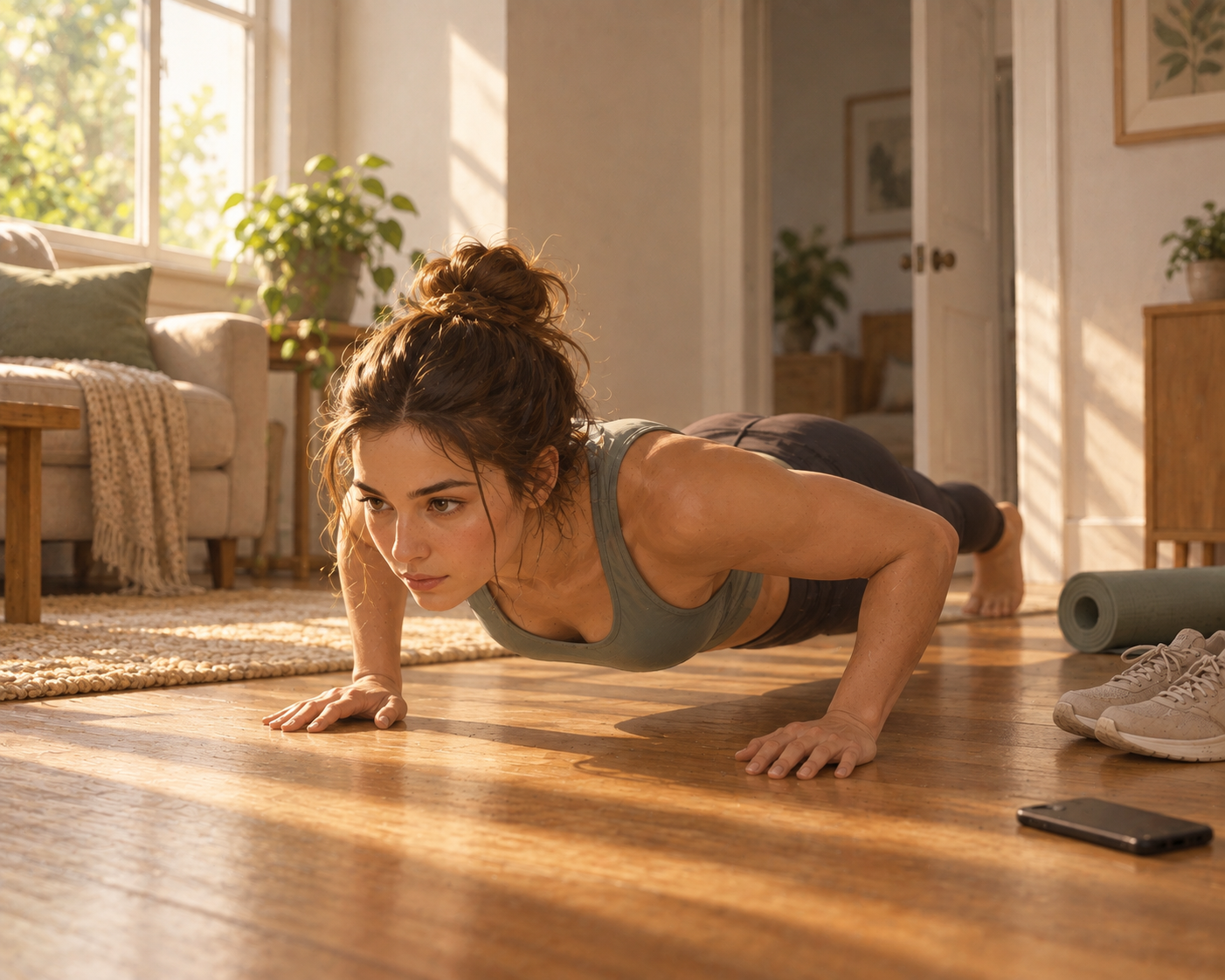
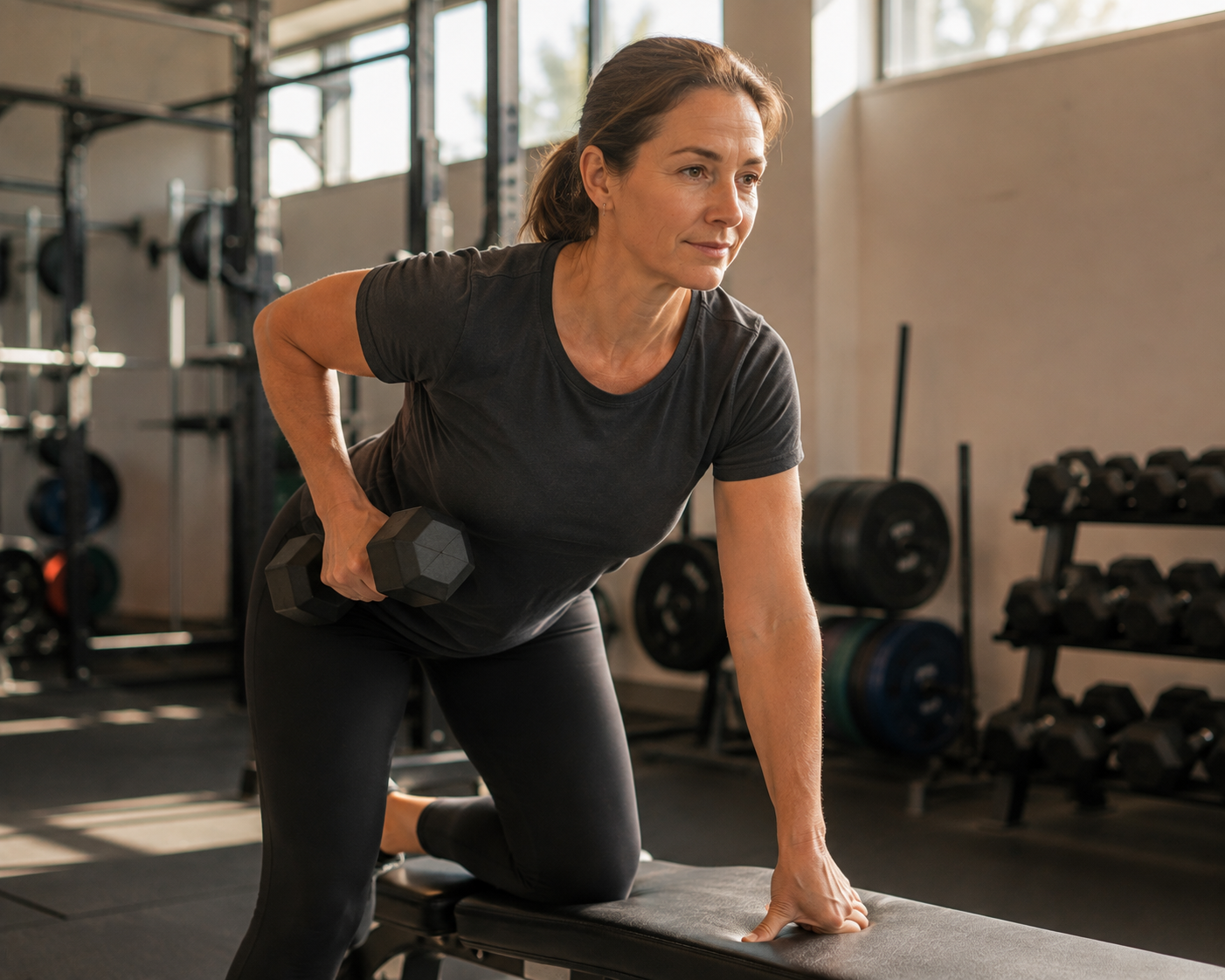
Ask a woman who avoids the weights room why, and you'll usually get some version of the same answer: she doesn't want to get bulky. It's such a common concern that most fitness content leads with reassurance — don't worry, you won't.
That reassurance is broadly accurate, and we'll go through why. But it's also a slightly strange place to start, and it's worth noticing that before we get to the physiology. The far more important story is what happens to a female skeleton over the decades if nobody ever loads it — and that's a story about fractures in your seventies, decided largely by what you do in your forties and fifties.
What the research actually says about women and muscle growth
The honest answer is more interesting than "women can't build muscle": relative growth is comparable, absolute growth is not.
A systematic review and meta-analysis in the Journal of Strength and Conditioning Research compared responses to identical resistance training protocols in young to middle-aged men and women. Effect sizes for hypertrophy and lower-body strength were similar between the sexes — and, notably, there was a significant effect favouring women for upper-body strength gains.
A more recent Bayesian meta-analysis in PeerJ sharpened the picture by separating absolute from relative change. Absolute increases in muscle size slightly favoured males, but relative increases — the percentage change from your own starting point — were similar between sexes. The authors concluded that women have a similar potential to induce hypertrophy as men.
So why does the visual outcome differ so much? Because a similar percentage gain applied to a smaller starting muscle mass produces a much smaller absolute change. Add substantially lower circulating testosterone, and the result is that muscle accrues slowly and gradually rather than appearing overnight. Women who do develop visibly muscular physiques have generally trained hard and deliberately for years to get there.
❌ The fear
"I'll pick up a barbell in January and by spring I'll have accidentally acquired a physique I didn't want and can't undo."
✅ The reality
Muscle accrues slowly and visibly changes little year on year. It's also reversible if you stop. Nobody has ever built a significant amount of muscle by accident.
A note on the reassurance itself
It's worth saying plainly: "don't worry, you won't get bulky" quietly accepts that muscle on a woman would be a bad outcome. That's a cultural judgement rather than a health one, and it's the reason the myth has been so durable.
Some women genuinely want to build visible muscle, and that's a legitimate goal that takes years of committed work. Others don't, and that's equally fine. The useful point isn't that muscle is undesirable — it's that the amount you gain is under your control, arrives slowly enough to steer, and is nothing like the runaway process the fear implies. You get to decide where to stop.
Key insight: The question "will this make me bulky?" is answerable and reassuring. But it's a smaller question than the one nobody asks, which is what happens to your bones and muscle if you never train at all.
The argument that actually matters: bone
Bone responds to load, and lifting heavy is one of the few interventions that reliably applies enough of it — including in women who already have low bone density, which is where the received wisdom used to say the opposite.
The LIFTMOR randomised controlled trial, published in the Journal of Bone and Mineral Research, recruited postmenopausal women with low bone mass — osteopenia and osteoporosis — and randomised them to either eight months of twice-weekly, 30-minute supervised high-intensity resistance and impact training, or a home-based low-intensity programme. The heavy training group used sets of five repetitions at over 85% of their one-repetition maximum. Deadlifts, overhead press, back squats.
The high-intensity group improved bone mineral density at the lumbar spine and femoral neck, along with measures of physical function, compared with the control group.
What makes this study genuinely significant is that it was designed partly to test safety. High-intensity training had traditionally been withheld from people with osteoporosis because of a perceived fracture risk. A companion analysis reported that the high-intensity exercise did not cause vertebral fractures and actually improved thoracic kyphosis — the forward curvature of the upper spine that people associate with ageing.
The programme was supervised, and that matters — this isn't an argument for loading a heavy bar unsupervised with untested technique. But it substantially undercuts the idea that women with fragile bones should stick to gentle movement.
Why the timing is urgent
Bone density peaks in early adulthood and declines from there, and for women the decline accelerates sharply around menopause as oestrogen falls. Oestrogen restrains bone breakdown; when it drops, the balance between building and resorbing tips the wrong way for several years.
This creates a window in which loading is unusually valuable. Training in your thirties and forties builds a higher peak to decline from. Training through and after menopause slows the decline and improves the strength, balance and coordination that determine whether a stumble becomes a fracture.
Falls are the other half of that equation and the half that gets neglected. Fracture risk isn't only about bone density — it's also about whether you can catch yourself, whether your legs can arrest a trip, and whether you can get up unassisted. Those are trainable, at any age.
What women often gain fastest
Early progress in resistance training is largely neurological — your nervous system learning to recruit muscle it already has — which is why strength climbs quickly long before size changes at all.
For many women this is the most satisfying phase, and it arrives within weeks. The upper-body finding from the Roberts meta-analysis is relevant here: women showed greater relative gains in upper-body strength than men in those studies, likely because they typically start from a lower baseline of upper-body training. Going from unable to do a press-up to doing several is a large percentage change, and it happens fast.
In older adults the pattern holds too. A meta-analysis in Sports Medicine covering 30 studies and 1,410 participants over 50 found that women gained more relative lower-body strength than men from identical training, though men gained more in absolute terms. Whether the sexes look different depends heavily on which way you present the numbers — which is worth remembering whenever someone tells you what women can or can't do in the gym.
How to actually train
Cover the main movement patterns, and make the load go up over time — that second part is what most beginner programmes get wrong, not the exercise selection.
🏋️ The patterns worth covering
- SquatGoblet squat, leg press, split squat — legs, hips and the getting-off-the-floor pattern
- HingeRomanian deadlift, hip thrust, deadlift — the strongest loader of hip and spine bone
- PushPress-up, overhead press, bench press — where relative gains tend to come fastest
- PullRow, lat pulldown, assisted chin-up — upper back, posture, grip
- CarryFarmer's walk, suitcase carry — the most transferable thing you can train
The practical version:
- Two to three sessions a week is plenty. The LIFTMOR bone protocol used two supervised 30-minute sessions. Frequency isn't the bottleneck; progression is.
- Lift heavy enough to be challenged. Sets of pink dumbbells for twenty reps will not load bone meaningfully. Work in a range where the last couple of repetitions are genuinely hard, with good technique maintained throughout.
- Progress the load, not just the reps. This is where equipment matters most. Bowflex SelectTech 552 adjustable dumbbells move in 2.5lb increments through the lower range, which is exactly the granularity that makes steady progression possible at home.
- Start where you are, not where you think you should be. If a loaded barbell is intimidating, a set of resistance bands and bodyweight work builds the pattern and the confidence first. Everyone starts somewhere; nobody's first session is impressive.
- Add load to your walking. A weighted vest such as the Sportneer Adjustable Weighted Vest increases the load through your legs and spine on ordinary walks. Start light and build gradually, and skip it if you have existing back or neck problems until you've asked a physio.
- Get coaching if you can. A handful of sessions with a decent coach for deadlift and squat technique is the best money most beginners spend — and the LIFTMOR programme was supervised throughout.
Eating enough protein is the other half of this, since training gives the stimulus and protein gives the material — we covered why that matters most over decades in why protein is the one macro that decides how you age. If joint pain is what's been holding you back, loading joints that already hurt is the companion read.
An honest caveat about the evidence
Women are significantly underrepresented in exercise science, and it's worth knowing that when reading confident claims in either direction. Much of what gets presented as general training advice comes from studies conducted primarily on male participants, which has left real gaps in understanding female-specific adaptations — including around the menstrual cycle, hormonal contraception and the menopausal transition.
That's a reason for humility about the details, not a reason to wait. The broad findings — that women respond well to resistance training, that loading builds bone, that strength predicts independence later — are consistent and well supported. The fine print is still being written.
Two practical notes. If you're pregnant or postpartum, resistance training is generally encouraged but the specifics warrant individual guidance from your midwife, GP or a specialist physio. And if you have diagnosed osteoporosis, existing fractures or spinal problems, get individualised advice before starting heavy loading — LIFTMOR's participants were screened and supervised, which is part of why it went well.
Measuring the right things
The scale is a poor instrument for this, because muscle gained and fat lost can offset each other and leave the number unmoved for months while your body composition changes underneath. Judging resistance training by weight is how people quit something that's working.
Better markers: the weight on the bar, the number of repetitions at a given load, how you feel carrying shopping up stairs, whether you can get off the floor without using your hands. Those improve steadily and honestly. Logging them alongside your energy and sleep over months is what makes slow progress visible — which is what Health Mentor AI is designed to hold onto, and it's the same argument we made in the plateau survival guide: the trend is the thing, not the day.
The reframe worth keeping: you're not training to change how you look in six weeks. You're training so that at seventy-five you can carry your own bags, get up off the floor unaided, and survive a stumble that would otherwise put you in hospital. That's the actual return on two sessions a week — and it compounds quietly from whenever you start.
Frequently Asked Questions
Will lifting weights make a woman bulky?
Not in the way most people fear. A Bayesian meta-analysis found that absolute increases in muscle size slightly favoured males, while relative increases from baseline were similar between the sexes. Because women start from a smaller absolute muscle mass, the same percentage gain produces a much smaller visible change, and it accrues over years rather than weeks.
Does resistance training improve bone density in women?
Yes. In the LIFTMOR randomised controlled trial, postmenopausal women with osteopenia or osteoporosis who did twice-weekly supervised high-intensity resistance and impact training for eight months showed improvements in bone mineral density and physical function compared with a low-intensity home programme.
Is heavy lifting safe if you already have low bone density?
The LIFTMOR trial specifically monitored adverse events in postmenopausal women with low bone mass and found the supervised programme was well tolerated, with a follow-up analysis reporting no vertebral fractures and improved thoracic kyphosis. Supervision and technique matter, so working with a qualified coach and discussing it with your doctor is sensible.
How often should women strength train?
Two to three sessions a week covering the major movement patterns is enough for most people. The LIFTMOR bone programme used just two supervised 30-minute sessions weekly. What matters more than frequency is that the load increases over time — training that stays at the same weight for months stops producing adaptation.
Scientific References
- Watson et al. (2018), Journal of Bone and Mineral Research — High-intensity resistance and impact training improves bone mineral density and physical function in postmenopausal women with osteopenia and osteoporosis: the LIFTMOR randomized controlled trial
- Watson et al. (2019), Osteoporosis International — High-intensity exercise did not cause vertebral fractures and improves thoracic kyphosis in postmenopausal women with low to very low bone mass: the LIFTMOR trial
- Roberts, Nuckols & Krieger (2020), Journal of Strength and Conditioning Research — Sex differences in resistance training: a systematic review and meta-analysis
- Refalo et al. (2025), PeerJ — Sex differences in absolute and relative changes in muscle size following resistance training in healthy adults: a systematic review with Bayesian meta-analysis
- Jones et al. (2021), Sports Medicine — Sex differences in adaptations in muscle strength and size following resistance training in older adults: a systematic review and meta-analysis
Products Mentioned in This Article
These products were referenced throughout the article to help you start and progress resistance training.
Fit Simplify Resistance Loop Exercise Bands (Set of 5)
A low-cost, low-intimidation starting point for learning movement patterns and building confidence before adding external load. Five resistance levels give you somewhere to progress to, and they take up no space at all.
View on Amazon →Bowflex SelectTech 552 Adjustable Dumbbells
Adjust from 5 to 52.5lb, with 2.5lb increments through the lower range — which is the fine-grained progression that makes consistent overload possible at home. A significant purchase, but it replaces roughly fifteen pairs of dumbbells.
View on Amazon →Sportneer Adjustable Weighted Vest
Adds load to ordinary walking, which puts more mechanical stress through the legs and spine than walking alone. Adjustable from light to substantial so you can build gradually. Worth checking with a physio first if you have existing back or neck issues.
View on Amazon →As an Amazon Associate, we earn from qualifying purchases. This comes at no additional cost to you.