
Four weeks in. You haven't missed a session, you're sore in places you didn't know existed, and when you look in the mirror you see exactly the same person who signed up a month ago. It's the point at which a lot of people decide the gym "doesn't work for them" and quietly stop going.
It's also the point at which a lot is already happening. Strength training changes your body in a predictable sequence, and the visible part comes last. This guide covers how long it takes to see results from the gym, what changes at each stage, and how to know it's working long before the mirror catches up.
How long does it take to see results from the gym?
Most people feel stronger within two to four weeks, see measurable changes in muscle within a month or two, and notice visible changes in their body after about 8–12 weeks of consistent training. Bigger changes in physique typically take three to six months or more.
📅 The strength training results timeline
- Weeks 1–2Muscle soreness, learning the movements, better mood and energy after sessions.
- Weeks 2–6Rapid strength gains, mostly from your nervous system. Weights that felt heavy start to feel manageable.
- Weeks 4–8Muscle growth is under way and measurable on scans, but still subtle to the eye.
- Weeks 8–12Visible changes for many people: clothes fit differently, shoulders and legs look more defined.
- 3–6 months+Clear changes in shape and body composition, provided training keeps progressing.
Everyone's timeline is different. Your starting point, genetics, age, sleep, diet and how consistently you train all shift it. But the order of events is remarkably similar for almost everyone.
Why do you get stronger before you look different?
Because the first changes are in your nervous system, not your muscles. In the early weeks, your brain gets better at recruiting muscle fibres, coordinating the muscles involved and switching off the ones that work against the movement. You can lift noticeably more with the same muscle.
This was shown in a classic study in the American Journal of Physical Medicine, which found that neural factors accounted for most of the strength gained in the first weeks of training, with muscle growth contributing more as training continued. Later research confirms the pattern. In a study in the Journal of Applied Physiology, maximal leg strength rose by about 39% in just 35 days of high-intensity training.
Key insight: If the weights are going up, it's working. Strength is the earliest and most reliable sign of progress, and it's the one most beginners ignore while staring at the mirror.
How quickly does muscle actually grow?
Measurably within a few weeks, visibly within a couple of months. In the same Journal of Applied Physiology study, MRI scans detected a 3.5–5% increase in thigh muscle size after just 20 days, rising to about 6.5–7.5% by day 35. That's real growth, but a few percent is very hard to see.
There's an important twist. Early in a new programme, much of your body's muscle-building effort goes into repairing damage from unfamiliar exercise. A study in The Journal of Physiology took muscle samples at the start of training, at three weeks and at ten weeks. Muscle damage was highest at the start and minimal by week ten. Muscle protein building only lined up with actual growth once the damage had settled, and fibre size increased significantly only at the ten-week mark.
In plain terms: the first few weeks are partly about your muscles getting used to training. Once they have, the growth becomes more efficient, which is one reason results seem to "kick in" after the first couple of months.
When will you see a visible difference?
Usually after around 8–12 weeks, sooner if you're also losing fat. By then, the combination of a little more muscle and a little less fat is often enough to change how your clothes fit and how you look in photos.
A review in Current Sports Medicine Reports summarised that ten weeks of resistance training can, on average, increase lean mass by about 1.4 kg, reduce fat mass by about 1.8 kg and raise resting metabolic rate by about 7%. Notice what that does to the scale: a net change of just 0.4 kg, even though your body composition has shifted by more than 3 kg. That's why weight alone is such a poor measure of progress, as we explain in why the scale won't budge.
What other results come from strength training?
Plenty that never show in a mirror. Resistance training lowers resting blood pressure, improves mood and reduces depressive symptoms, and builds the strength that keeps everyday life easy as you get older.
- Blood pressure: a network meta-analysis of 270 trials in the British Journal of Sports Medicine found dynamic resistance training lowered resting blood pressure by around 4.6/3.0 mmHg, similar to aerobic exercise.
- Mood: a meta-analysis of 33 randomised trials in JAMA Psychiatry found resistance training significantly reduced depressive symptoms, regardless of how much training people did.
- Everyday strength: carrying shopping, getting up off the floor and climbing stairs all get easier, often within the first month.
Why are you not seeing results from the gym?
The most common reasons are a lack of progression, inconsistent training, too little protein, poor sleep, or simply not enough time yet. Genetics affects the rate of progress, but almost everyone who trains consistently and progressively improves.
- The same weights every week. If nothing gets harder, your body has no reason to change. See the golden rule of gains.
- Missed sessions. Two sessions a week, every week, beats four sessions some weeks.
- Too little protein. Around 1.6 g per kg of body weight a day is a sensible target. See what to eat before and after a workout.
- Short sleep. Most recovery happens overnight.
- Judging too early. Four weeks is the start of the story, not the verdict.
- Comparing with others. People respond to the same training very differently. See the comparison trap.
If you're just starting out, our beginner guides for women and for men give you a complete 12-week plan to follow. If you're already training well and want an evidence-based extra, creatine is one of the few supplements with solid evidence for strength gains.
How do you know your training is working?
Track your strength, your measurements and your photos, and judge them over months, not days. These show progress weeks before your reflection does, and they're what keep you going through the slow early stretch.
- Your lifts: weights and reps for each exercise, every session. This is the earliest signal.
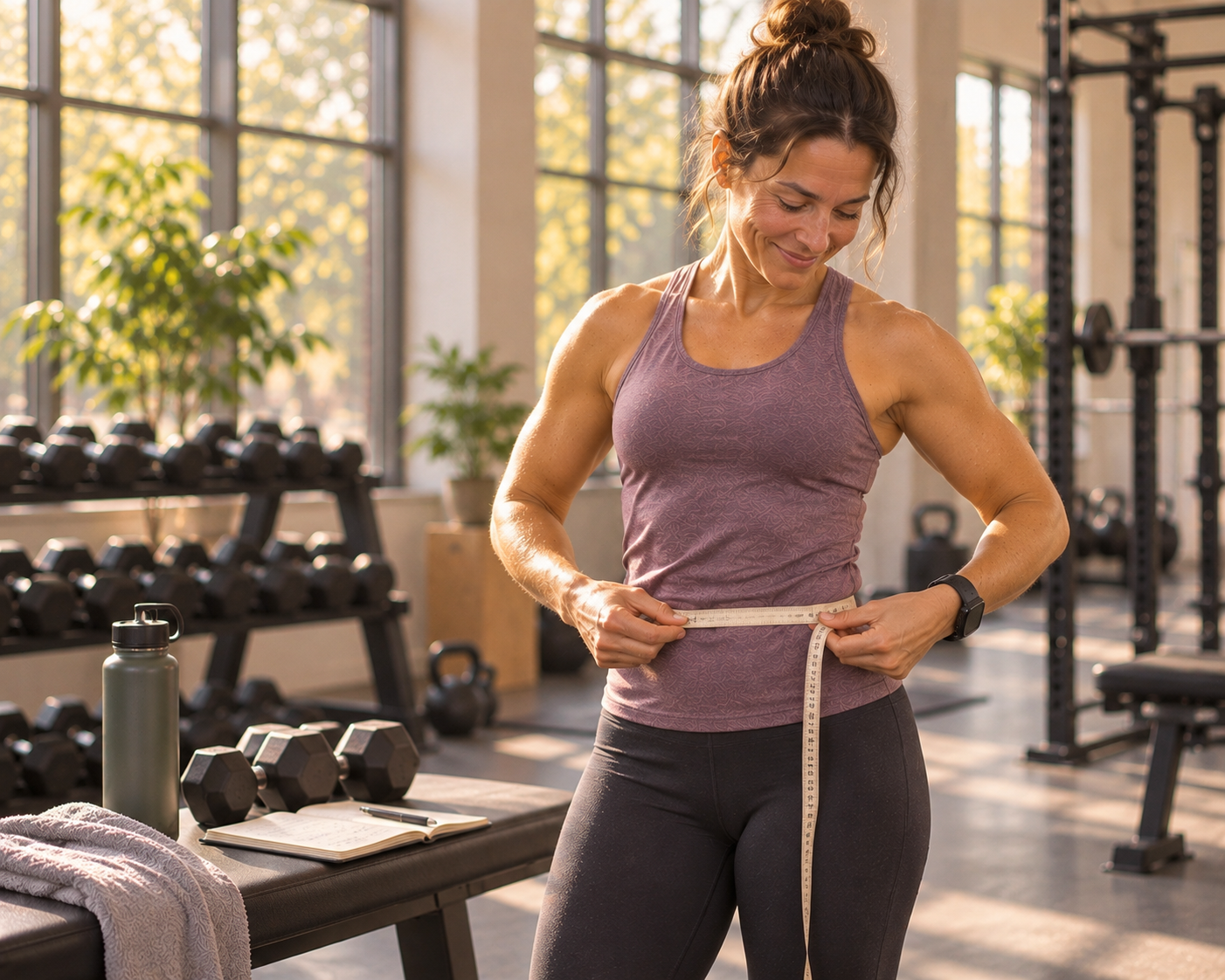
- Measurements: waist, hips, arms and thighs every two to four weeks. A tape such as the MyoTape Body Tape Measure pulls to the same tension every time, so measurements are comparable.
- Photos: once a month, same place, same light, same time of day.
- The scale: as a weekly average, alongside the measurements, never on its own.
A training notebook like the &And Per Se Fitness Workout Journal works well. Health Mentor AI goes further: it logs every set, rep and weight, and its analysis and compare tools show how your training has progressed over time. Monthly and quarterly summaries put your progress side by side, so in week four, when the mirror says nothing has changed, your numbers can show you that a lot already has.
The bottom line
You'll feel stronger within weeks, your muscles will be growing within a month or two, and you'll usually see the difference by around three months. The people who get results aren't the ones with the best genetics or the perfect programme. They're the ones still training in week twelve.
Get the app, log today's session, and give it twelve weeks before you judge.
Frequently Asked Questions
How long does it take to see results from the gym?
Most people feel stronger within two to four weeks, have measurable muscle growth within a month or two, and notice visible changes after around 8 to 12 weeks of consistent training. Larger changes in physique usually take three to six months or more, depending on starting point, diet, sleep and consistency.
Why am I getting stronger but not bigger?
Early strength gains come mainly from your nervous system learning to recruit and coordinate muscle more effectively, rather than from muscle growth. In one study, maximal strength rose by about 39 percent in 35 days. Muscle growth contributes more as training continues, and visible size changes typically appear after a couple of months.
How fast do muscles grow when you start lifting?
Muscle growth starts within weeks but is small at first. In one study, MRI scans detected a 3.5 to 5 percent increase in thigh muscle size after 20 days of training. Early in a programme, some of the muscle-building response goes into repairing damage from unfamiliar exercise, and growth becomes more efficient after the first few weeks.
Why am I not seeing results from the gym?
The most common reasons are using the same weights every week, missing sessions, eating too little protein, sleeping poorly, or judging results too early. Track your lifts and measurements rather than relying on the mirror or the scale, and make sure your training gets slightly harder over time through more weight, reps or sets.
Should I weigh myself to track gym progress?
Use the scale alongside other measures rather than on its own. Ten weeks of resistance training can add around 1.4 kg of lean mass and remove around 1.8 kg of fat, which barely moves the scale. Weekly average weight, waist and limb measurements, monthly photos and your training log together give a much clearer picture.
Scientific References
- Moritani & deVries (1979), American Journal of Physical Medicine — Neural factors versus hypertrophy in the time course of muscle strength gain
- Seynnes, de Boer & Narici (2007), Journal of Applied Physiology — Early skeletal muscle hypertrophy and architectural changes in response to high-intensity resistance training
- Damas et al. (2016), The Journal of Physiology — Resistance training-induced changes in integrated myofibrillar protein synthesis are related to hypertrophy only after attenuation of muscle damage
- Westcott (2012), Current Sports Medicine Reports — Resistance training is medicine: effects of strength training on health
- Edwards et al. (2023), British Journal of Sports Medicine — Exercise training and resting blood pressure: a large-scale pairwise and network meta-analysis of randomised controlled trials
- Gordon et al. (2018), JAMA Psychiatry — Association of efficacy of resistance exercise training with depressive symptoms: meta-analysis and meta-regression of randomized clinical trials
Products Mentioned in This Article
Progress you can't see yet is still progress you can measure. These two make the measuring easy.
MyoTape Body Tape Measure
A one-handed, self-tensioning tape for waist, hip, arm and thigh measurements. Because it pulls to the same tension every time, your monthly numbers are genuinely comparable, which matters when changes are only a centimetre or two.
View on Amazon →&And Per Se Fitness Workout Journal (A5, Black)
An undated hardback log for every exercise, set and weight. Flicking back to week one in week twelve is one of the most motivating moments in any training programme.
View on Amazon →As an Amazon Associate, we earn from qualifying purchases. This comes at no additional cost to you.