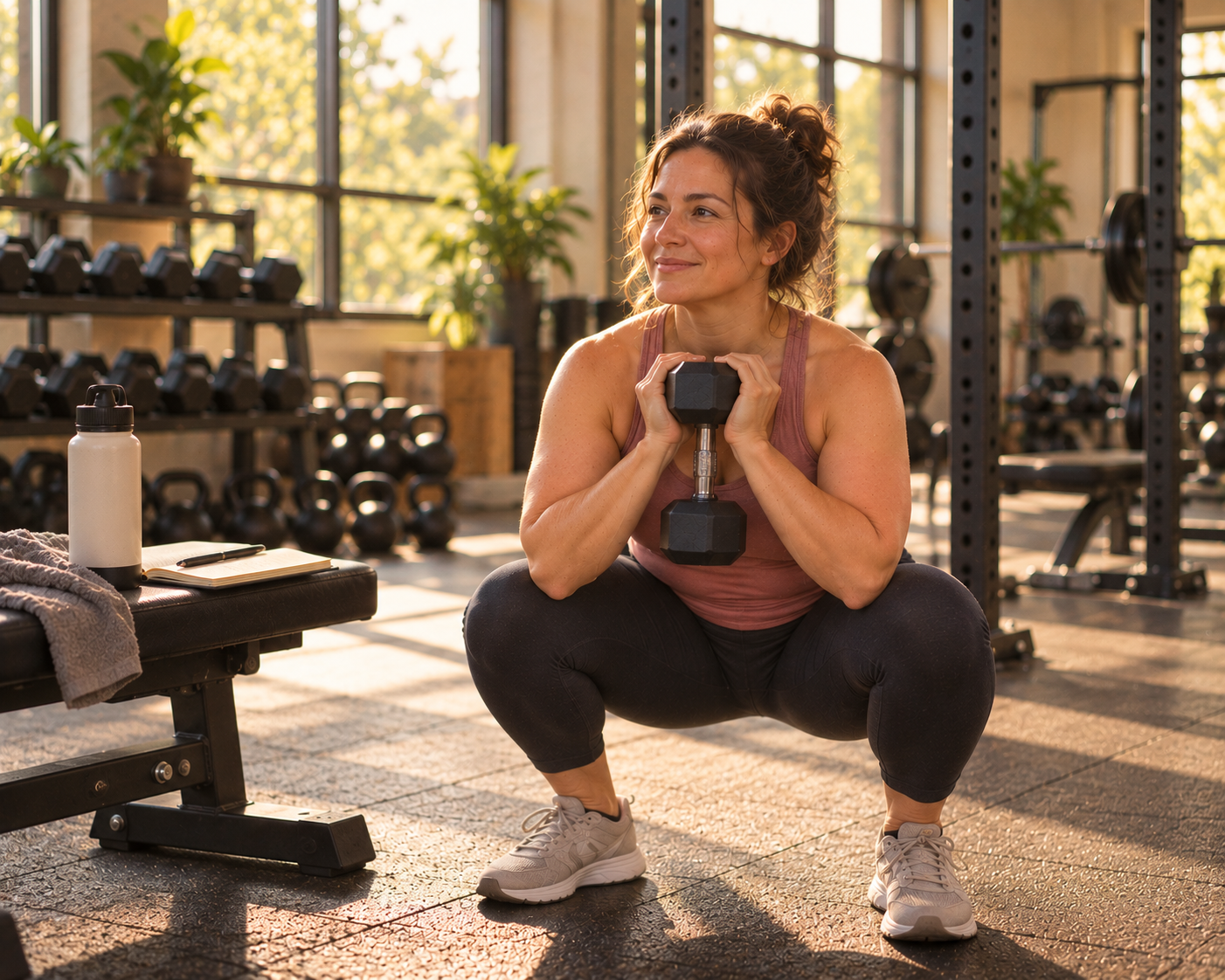
Maybe a friend has started lifting and won't stop talking about how good she feels. Maybe your doctor mentioned bone health, or you've simply noticed that carrying the shopping up the stairs is harder than it used to be. Either way, you've decided this is the year you start weight training, and the first question is the obvious one: where do you actually begin?
The honest answer is that it's simpler than it looks. You don't need a complicated split, expensive supplements or hours in the gym. You need a handful of basic exercises, a sensible starting weight and a plan that gets a little harder each week. This guide to weight training for women covers all three, finishing with a 12-week beginner programme you can follow at the gym or at home.
Why should women start weight training?
Because it improves almost everything you might care about: strength, body composition, metabolic health, mood and long-term health. Strength training is one of the few habits linked to a lower risk of early death, heart disease, diabetes and some cancers, and the benefits begin at modest weekly amounts.
A meta-analysis of 16 cohort studies in the British Journal of Sports Medicine found that people who did muscle-strengthening activities had a 15% lower risk of death from any cause and a 17% lower risk of both cardiovascular disease and diabetes. The greatest reductions were seen at around 30–60 minutes a week. When combined with aerobic exercise, the reduction in all-cause mortality rose to 40%.
The changes show up in the body, too. A review in Current Sports Medicine Reports summarised that ten weeks of resistance training can increase lean mass by about 1.4 kg, reduce fat mass by about 1.8 kg and raise resting metabolic rate by around 7%. And it's good for your head: a meta-analysis of 33 randomised trials in JAMA Psychiatry found resistance training significantly reduced depressive symptoms, regardless of training volume or health status.
For a deeper look at bone density and what to expect from your physique, see our earlier article, Strength Without Bulk.
Do women need a different training programme?
No. Women respond to resistance training in much the same way as men in relative terms, so the same principles apply: train the major muscle groups, use challenging weights and progress gradually. A good beginner programme is a good beginner programme for anyone.
A 2025 systematic review with Bayesian meta-analysis in PeerJ, covering 29 studies of healthy adults, found that relative increases in muscle size were similar between women and men, and lower-body growth was similar in absolute terms too. The authors concluded that females have a similar potential to build muscle as males.
What does differ is individual: your starting strength, your goals, any injuries, and how much time you have. That's where the plan should flex, not on the basis of gender.
How often should a beginner lift weights?
Two full-body sessions a week is an ideal starting point, with an optional third session once you're settled. Each session takes 40–45 minutes including a warm-up. That fits comfortably within the 30–60 minutes a week linked to the biggest health benefits, with room to grow.
The American College of Sports Medicine's 2026 overview of reviews, covering 137 systematic reviews, emphasised that the programme you'll actually stick to matters more than the finer details. For beginners, that means choosing days you can protect, such as Monday and Thursday, and treating them like any other appointment. Leave at least one rest day between sessions to begin with.
Which exercises should a beginner start with?
Start with one exercise for each of five basic movement patterns: squat, hinge, push, pull and carry. Between them they train every major muscle group, and every advanced exercise is a variation of one of them. Pick the version that suits your equipment and current strength.
🏋️ The five movements and beginner versions
- SquatGoblet squat (holding one dumbbell at your chest), leg press, or bodyweight squat to a chair. Trains thighs and glutes.
- HingeDumbbell Romanian deadlift, glute bridge or hip thrust. Trains the glutes, hamstrings and lower back, and teaches you to lift safely from the floor.
- PushIncline push-up (hands on a bench or kitchen worktop), dumbbell bench press or dumbbell shoulder press. Trains chest, shoulders and triceps.
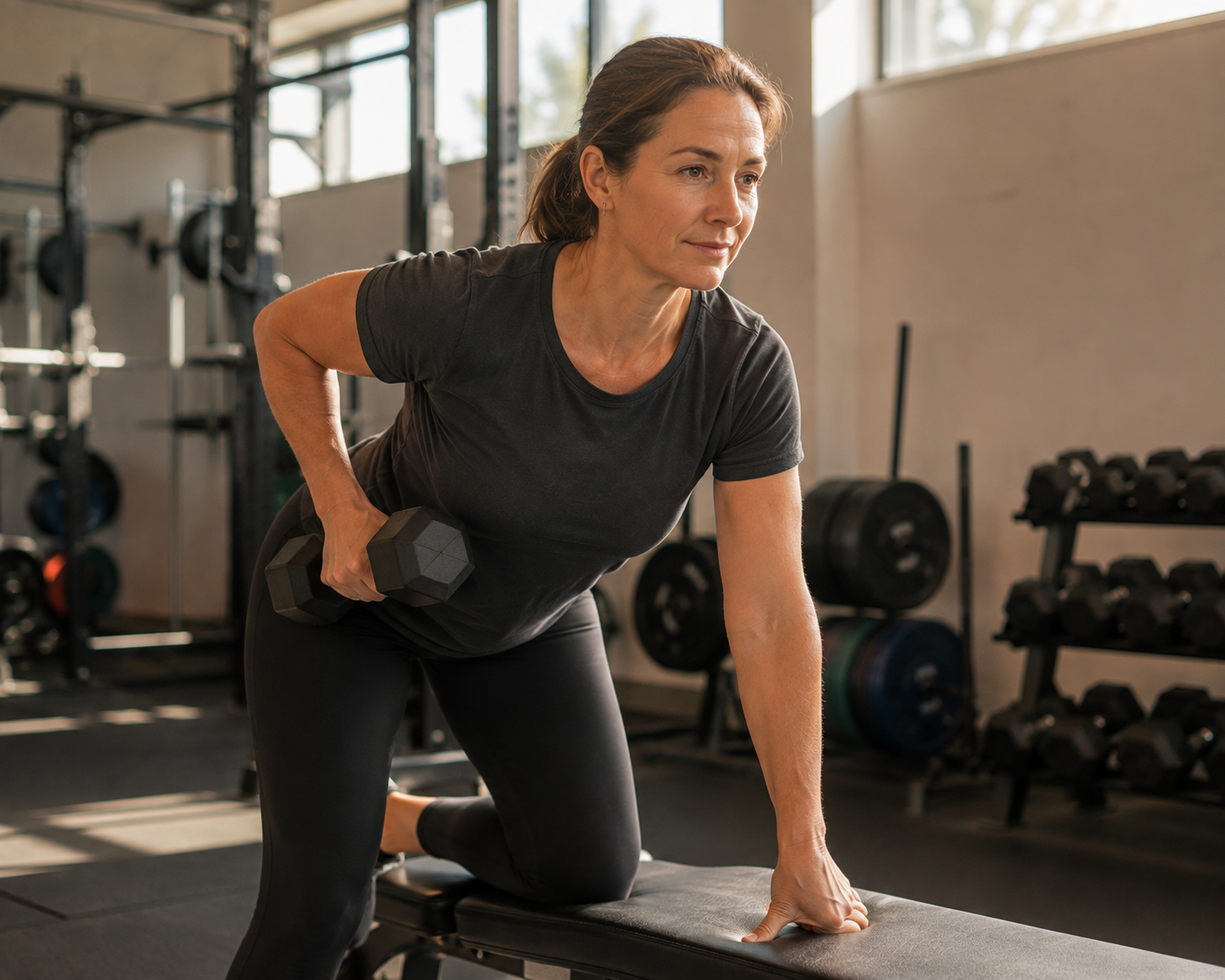
- PullSeated cable row, lat pulldown, one-arm dumbbell row or resistance band row. Trains the back and biceps, and helps posture.
- CarryFarmer's carry: hold a dumbbell in each hand and walk tall. Trains grip, core and shoulders, and is about as practical as exercise gets.
Add a simple core exercise such as a plank or dead bug at the end, and you have a complete session. Training at home? A pair of dumbbells and a set of resistance bands, such as Fit Simplify Resistance Loop Exercise Bands, cover every movement on the list. For bodyweight-only options, see building strength without a gym.
How heavy should a beginner lift?
Heavy enough that the last two or three reps of each set feel genuinely challenging, but light enough that your form stays smooth throughout. A good test is "reps in reserve": when you finish a set, you should feel you could have done two or three more good reps, not zero and not ten.
In the first two weeks, err on the light side. Your priority is learning the movements, and your nervous system learns fast: much of a beginner's early strength gain comes from the brain and muscles getting better at working together, not just from muscle growth. That's why the weights you use will feel noticeably easier within a few weeks, which is your cue to progress.
Key insight: If you're unsure, pick a weight you think you could lift about 15 times, then do 10. It feels almost too easy on day one. By week four it won't.
Three form cues apply to almost every exercise: brace your stomach as if you're about to be prodded, move with control rather than momentum, and breathe out on the effort. If anything causes sharp or joint pain (rather than muscle effort), stop, lighten the load or switch to a different version.
Your 12-week beginner weight training plan
Alternate between two workouts, A and B. Start each with five minutes of brisk walking, cycling or rowing, plus one light warm-up set of the first exercise. Rest 60–90 seconds between sets.
🅰️ Workout A
- Goblet squat8–12 reps
- Dumbbell Romanian deadlift8–12 reps
- Incline push-up or dumbbell bench press8–12 reps
- Seated cable row or band row10–12 reps
- Plank20–30 seconds
🅱️ Workout B
- Leg press or split squat8–12 reps (each leg for split squats)
- Glute bridge or hip thrust10–12 reps
- Lat pulldown or one-arm dumbbell row10–12 reps
- Dumbbell shoulder press8–12 reps
- Farmer's carry30–40 metres, or about 30 seconds
📅 How the 12 weeks progress
- Weeks 1–4: LearnTwo sessions a week (A then B). Two sets of each exercise, finishing with three or four reps in reserve. Focus entirely on technique and turning up.
- Weeks 5–8: BuildMove to three sets, finishing with two or three reps in reserve. When you reach the top of the rep range on every set, increase the weight slightly next session.
- Weeks 9–12: ProgressOptionally add a third weekly session (A-B-A one week, B-A-B the next). Keep adding reps, then weight. In week 12, compare your numbers with week 1.
That method of adding reps until you reach the top of the range, then adding weight, is called double progression. It's the simplest way to apply progressive overload, which we explain in the golden rule of gains.
What should you expect in the first few weeks?
Some muscle soreness, fast early strength gains and a scale that may not move much. All three are normal. Soreness usually peaks a day or two after a new session and fades quickly as your body adapts, typically within the first couple of weeks.
- Soreness: Mild stiffness 24–72 hours after training is expected early on. Gentle movement, such as a walk, helps. It isn't a measure of how good a workout was, so don't chase it.
- Strength: Expect the weights to feel lighter every week or two during the first couple of months. Enjoy it: this is the fastest progress you'll ever make.
- The scale: Building muscle while losing fat can leave your weight unchanged even as your shape changes. Measurements and how your clothes fit tell you more. See why the scale won't budge.
- Energy and sleep: Many people notice better sleep and more energy within a few weeks, though the first sessions can leave you tired.
How can you feel confident in the gym as a beginner?
Go in with a written plan, start with equipment you understand, and choose quieter times while you're learning. Confidence comes quickly with familiarity. Most people in a gym are far more focused on their own workout than on anyone else's.
- Book an induction. Most gyms offer a free session showing you how the machines work and where everything is.
- Have your plan on your phone. Knowing exactly what you're doing next removes most of the hesitation.
- Start with dumbbells and machines. They're easy to adjust and forgiving while you learn technique. Barbells can come later if you want them.
- Pick quieter times. Mid-morning, early afternoon and later evenings are usually calmer than straight after work.
- Bring a friend. Training with someone you know makes the first few weeks more fun, and you'll hold each other to the plan.
And if the gym simply isn't for you right now, the plan above works at home with dumbbells and bands. The best place to train is the one you'll keep going back to.
What should you eat to support weight training?
Focus on enough protein, spread across the day, and don't drastically cut calories while you're learning to lift. Protein provides the raw material for muscle repair, and most active adults do well on roughly 1.2–1.6 g per kilogram of body weight per day.
In practice, that means a palm-sized portion of protein at each meal: eggs, Greek yoghurt, chicken, fish, tofu, beans or lentils. It doesn't need to be expensive, as we show in protein on a budget. Sleep matters as much as food, because it's when most recovery happens.
How do you keep progressing after 12 weeks?
Keep a record of every session, and keep making small, steady increases. Beginners who track their workouts know exactly what to beat next time, which turns progress from guesswork into a plan.
A simple notebook like the &And Per Se Fitness Workout Journal does the job. Or let Health Mentor AI do it for you: it builds a weekly workout plan around your goals and equipment, logs every set and weight, shows what you lifted last time before you start, and its AI mentor can answer questions such as "what can I do instead of a lat pulldown?" in the moment.
Twelve weeks from now, you'll be lifting weights that feel heavy today, moving with confidence, and wondering why you didn't start sooner. Get the app and book your first session for this week.
Frequently Asked Questions
Should women lift weights?
Yes. Strength training benefits women's long-term health, body composition, bone health and mood. A meta-analysis of 16 cohort studies found muscle-strengthening activity was linked to a 15% lower risk of death from any cause, with the largest benefits at around 30 to 60 minutes per week. A separate meta-analysis of 33 trials found resistance training significantly reduced depressive symptoms.
How many days a week should a beginner woman lift weights?
Two full-body sessions a week is an ideal starting point, with at least one rest day in between. Each session takes about 40 to 45 minutes. After a month or two you can add an optional third session, but consistency matters far more than frequency when you are starting out.
How heavy should a beginner lift?
Choose a weight that makes the last two or three reps of each set challenging while your form stays smooth, leaving two or three reps in reserve. In the first couple of weeks go lighter: a weight you could lift about 15 times, used for 10 reps. Early strength gains come quickly, so you will be able to increase the weight within a few weeks.
Will weight training make women bulky?
Not unintentionally. Women build muscle at a similar relative rate to men, but absolute gains are smaller and muscle develops slowly, over months and years, with consistent training and eating. Most beginners notice they look more toned and feel stronger rather than bigger, and they can adjust their training and eating at any point.
Can women do weight training at home?
Yes. A pair of dumbbells and a set of resistance bands are enough to train all five basic movements: squat, hinge, push, pull and carry. Goblet squats, Romanian deadlifts, incline push-ups, band rows and farmer's carries make a complete beginner routine, and the same principles of progression apply as in a gym.
Scientific References
- Momma et al. (2022), British Journal of Sports Medicine — Muscle-strengthening activities are associated with lower risk and mortality in major non-communicable diseases: a systematic review and meta-analysis of cohort studies
- Westcott (2012), Current Sports Medicine Reports — Resistance training is medicine: effects of strength training on health
- Gordon et al. (2018), JAMA Psychiatry — Association of efficacy of resistance exercise training with depressive symptoms: meta-analysis and meta-regression of randomized clinical trials
- Refalo et al. (2025), PeerJ — Sex differences in absolute and relative changes in muscle size following resistance training in healthy adults: a systematic review with Bayesian meta-analysis
- Phillips et al. (2026), Medicine & Science in Sports & Exercise — Resistance training prescription for muscle function, hypertrophy, and physical performance in healthy adults: an overview of reviews
Products Mentioned in This Article
You don't need any equipment to start if you have a gym membership. These two are useful for training at home and keeping track of your progress.
Fit Simplify Resistance Loop Exercise Bands (Set of 5)
Five loop bands from extra light to extra heavy, with a carry bag. Ideal for glute bridges, band rows and warm-ups at home, and light enough to take on holiday so a week away doesn't break the routine.
View on Amazon →&And Per Se Fitness Workout Journal (A5, Black)
An undated hardback log for recording every exercise, set and weight. Writing it down is what lets you see your week-1 and week-12 numbers side by side, which is one of the most motivating moments of the whole programme.
View on Amazon →As an Amazon Associate, we earn from qualifying purchases. This comes at no additional cost to you.