You used to be reasonably fit. Maybe you played football or rugby at school, or had a phase at the gym in your twenties. Then came work, a commute, possibly children, and a decade or two of mostly sitting down. Now your lower back complains after a day in the garden, the stairs feel steeper than they used to, and you've decided it's time to get strong again.
Good decision. Whether you're 25 or 55, weight training is one of the most effective things you can do for your long-term health, and it's never too late to start. This guide to weight training for men explains why strength matters so much, which exercises to begin with, the mistakes that trip up most beginners, and a 12-week plan you can follow at the gym or at home.
Why does strength matter so much for men's health?
Because strength is one of the clearest markers of long-term health there is. Lower muscular strength is linked to a higher risk of early death and heart disease, and muscle-strengthening exercise is associated with lower risk of cardiovascular disease, diabetes and some cancers, even at modest weekly amounts.
The most striking evidence comes from the PURE study, published in The Lancet. Researchers measured grip strength in nearly 140,000 adults across 17 countries and followed them for around four years. Every 5 kg lower grip strength was associated with a 16% higher risk of death from any cause and a 17% higher risk of cardiovascular death. Grip strength was a stronger predictor of death than systolic blood pressure.
Key insight: Grip strength isn't magic in itself. It's a simple window onto your overall strength. The goal isn't to squeeze a gripper all day; it's to get stronger everywhere, and your grip will follow.
Training itself pays off directly. A meta-analysis of 16 cohort studies in the British Journal of Sports Medicine found muscle-strengthening activity was linked to a 15% lower risk of death from any cause and a 17% lower risk of cardiovascular disease, with the greatest benefit at around 30–60 minutes a week. Combined with aerobic exercise, the reduction in all-cause mortality reached 40%.
Can weight training lower blood pressure?
Yes, and by about as much as cardio. A large analysis of 270 randomised trials found that dynamic resistance training lowered resting blood pressure by around 4.6/3.0 mmHg. Isometric exercise, where you hold a position such as a wall sit or plank, produced the largest reductions of any exercise type.
That analysis, published in the British Journal of Sports Medicine, pooled 15,827 participants. Aerobic exercise lowered resting blood pressure by about 4.5/2.5 mmHg, combined aerobic and resistance training by about 6.0/2.5 mmHg, and isometric exercise by about 8.2/4.0 mmHg. Blood pressure tends to creep up through middle age, so this is one of the most practical reasons to start lifting.
That's why the plan below includes a wall sit. It takes a minute, needs no equipment and has some of the best blood pressure evidence in the exercise literature. If you have high blood pressure or a heart condition, check with your GP before starting, and avoid holding your breath during heavy efforts.
How often should a beginner lift weights?
Two full-body sessions a week is the ideal place to start, with an optional third once the habit is established. Each session takes 40–45 minutes including a warm-up. Full-body sessions train every major muscle twice a week, which suits beginners far better than a split where each muscle is trained once.
The American College of Sports Medicine's 2026 overview of reviews, covering 137 systematic reviews, emphasised that consistency matters more than any programme detail. Choose two days you can protect, such as Tuesday and Friday, and treat them as fixed appointments.
Which exercises should a beginner start with?
Choose one exercise for each of five movement patterns: squat, hinge, push, pull and carry. Together they train every major muscle, build the strength you use in daily life and protect the lower back. Start with dumbbell and machine versions, then progress to barbells if you want to.
🏋️ The five movements and beginner versions
- SquatGoblet squat, leg press or split squat. Builds the thighs and glutes and keeps getting up off the sofa (or the floor) easy for decades.
- HingeDumbbell Romanian deadlift or trap bar deadlift. Strengthens the glutes, hamstrings and back, and teaches you to lift from the floor without rounding your spine.
- PushDumbbell bench press, push-up or dumbbell shoulder press. Trains chest, shoulders and triceps.
- PullOne-arm dumbbell row, seated cable row or lat pulldown. Builds the upper back and helps counter hours hunched over a desk.
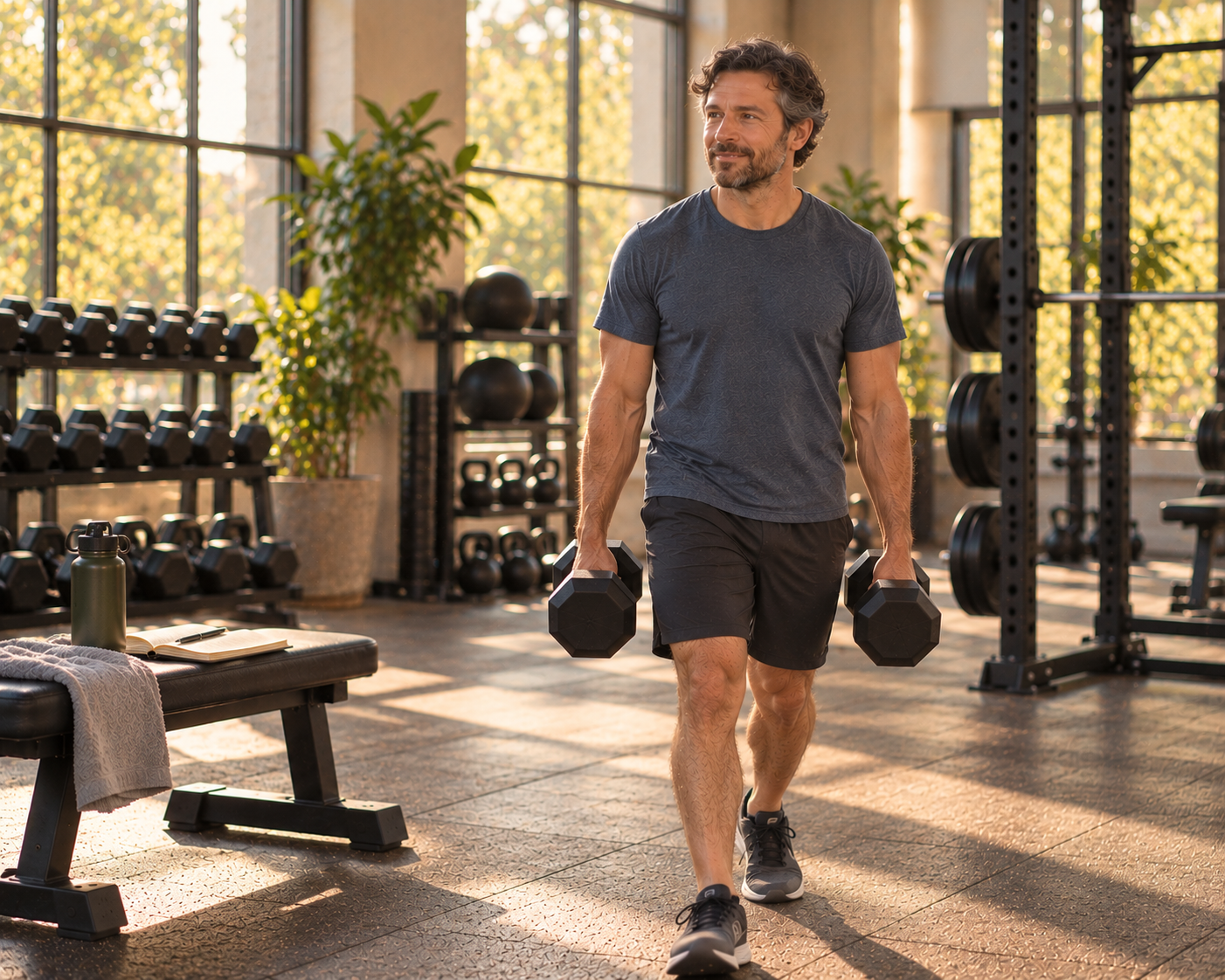
- CarryFarmer's carry: heavy dumbbells in each hand, walk tall. Builds grip, core and shoulder stability, and directly trains the strength measured in the grip studies.
Training at home works just as well with a pair of adjustable dumbbells, a bench and some resistance bands. For no-equipment options, see building strength without a gym.
What beginner mistakes should you avoid?
Going too heavy too soon is the big one, followed by training only the muscles you can see in the mirror and following no plan at all. Nearly every early injury or stall comes from one of these, and all of them are easy to avoid once you know about them.
- Lifting too heavy, too soon. Muscles adapt faster than tendons and joints. Leave your ego at the door for the first month and let technique lead.
- Pushing more than pulling. Lots of bench press and little rowing is a recipe for sore shoulders and rounded posture. Match every push with a pull.
- Skipping legs. Your legs and glutes are your biggest muscles and the ones that keep you mobile in later life. They're not optional.
- Random workouts. Doing whatever you feel like each session makes progress impossible to measure. Follow a plan and repeat it.
- Every set to failure. Grinding out every last rep piles up fatigue without adding much growth. Two or three reps in reserve is the sweet spot.
- Skipping the warm-up. Five minutes of light cardio and a light first set make every working set safer and stronger.
- Quitting in week three. Early soreness and slow visible change are normal. Strength improves first; the mirror catches up later.
How heavy should a beginner lift?
Heavy enough that the last two or three reps of each set are genuinely hard, but light enough that your form stays clean. Use "reps in reserve" as your guide: finish each set knowing you could have done two or three more good reps.
In the first two weeks, go lighter still. Much of a beginner's early strength gain comes from the nervous system learning to coordinate the movement, so you'll get stronger quickly even with modest weights. A useful rule is to choose a weight you could lift around 15 times and do 10. It should feel easy on day one. It won't by week four.
Three cues apply to almost every lift: brace your stomach before each rep, control the lowering phase rather than dropping the weight, and breathe out on the effort. Sharp or joint pain means stop and adjust. Muscle effort is fine.
Your 12-week beginner weight training plan
Alternate between Workout A and Workout B. Warm up with five minutes of brisk walking, cycling or rowing, plus one light set of the first exercise. Rest 60–90 seconds between sets, or up to two minutes on the first exercise.
🅰️ Workout A
- Goblet squat8–12 reps
- Dumbbell bench press8–12 reps
- One-arm dumbbell row10–12 reps each side
- Dumbbell Romanian deadlift8–12 reps
- Wall sitTwo holds of 30–45 seconds
🅱️ Workout B
- Trap bar or dumbbell deadlift6–10 reps
- Lat pulldown or band pulldown10–12 reps
- Dumbbell shoulder press8–12 reps
- Split squat8–10 reps each leg
- Farmer's carry30–40 metres, or about 30 seconds
📅 How the 12 weeks progress
- Weeks 1–4: LearnTwo sessions a week. Two sets per exercise, finishing with three or four reps in reserve. Master technique and build the habit.
- Weeks 5–8: BuildThree sets per exercise, two or three reps in reserve. When you hit the top of the rep range on every set, add a little weight next session.
- Weeks 9–12: ProgressOptionally add a third weekly session (A-B-A, then B-A-B). Keep adding reps, then weight. If you want to learn barbell lifts, this is a good time to book a session with a coach.
This "add reps, then add weight" approach is called double progression, and it's the simplest way to apply progressive overload. We explain the principle in full in the golden rule of gains.
How do you measure your progress?
Track your lifts every session, and pick one or two simple benchmarks to retest at the end of the 12 weeks. Your working weights tell you the most, but a couple of fixed tests make the change impossible to miss.
- Your logbook. Compare week 1 and week 12 weights and reps for each exercise. Most beginners are surprised by the difference.
- Grip strength. A simple CAMRY Digital Hand Dynamometer gives you the same measure used in the PURE study. Test both hands at the start, then again at week 12.
- Push-ups. How many good-form push-ups can you do in a row? Retest at the end.
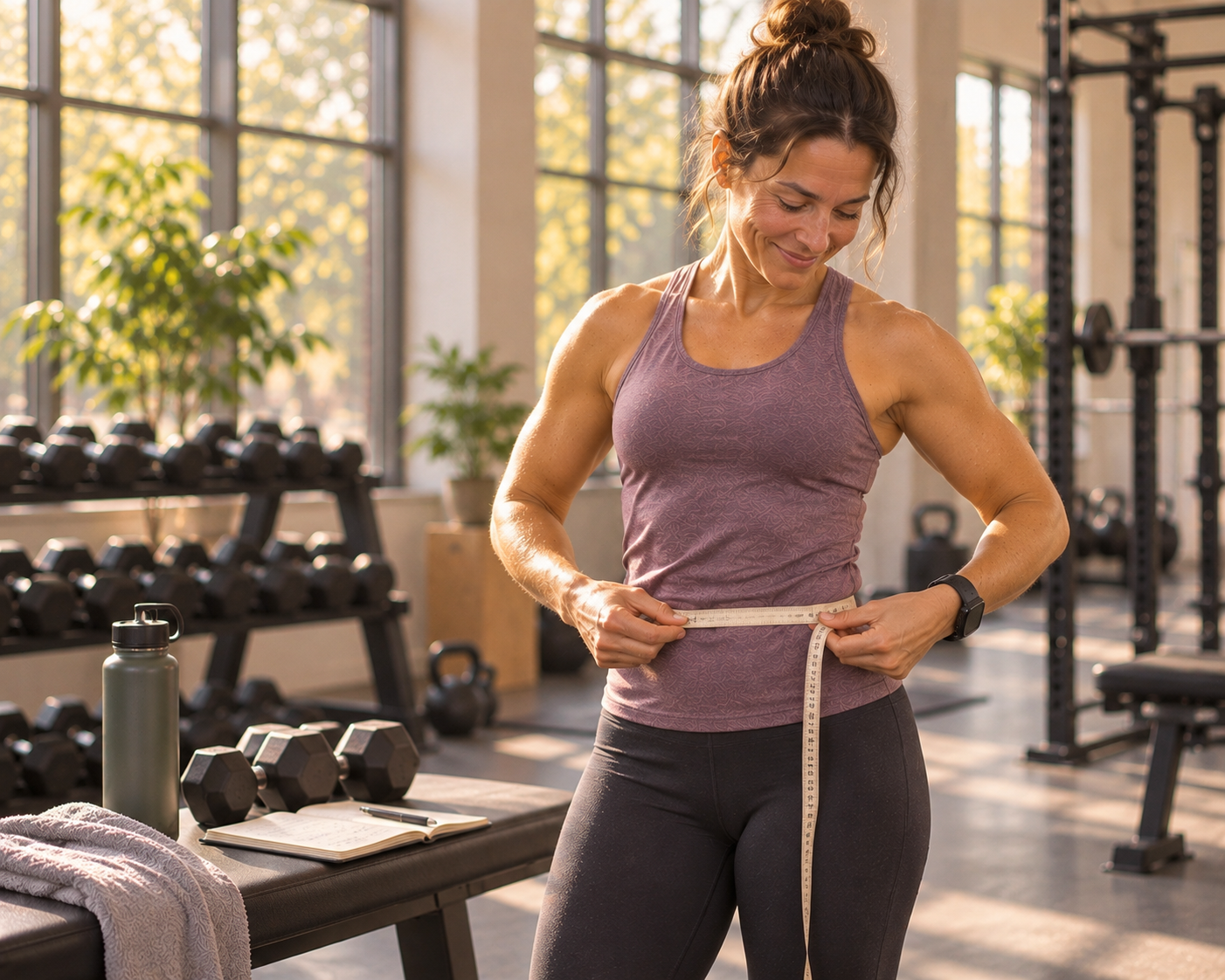
- Waist measurement. More informative than body weight when you're building muscle and losing fat at the same time.
- Resting blood pressure and heart rate. If you have a home monitor or a wearable, note your averages now and in three months.
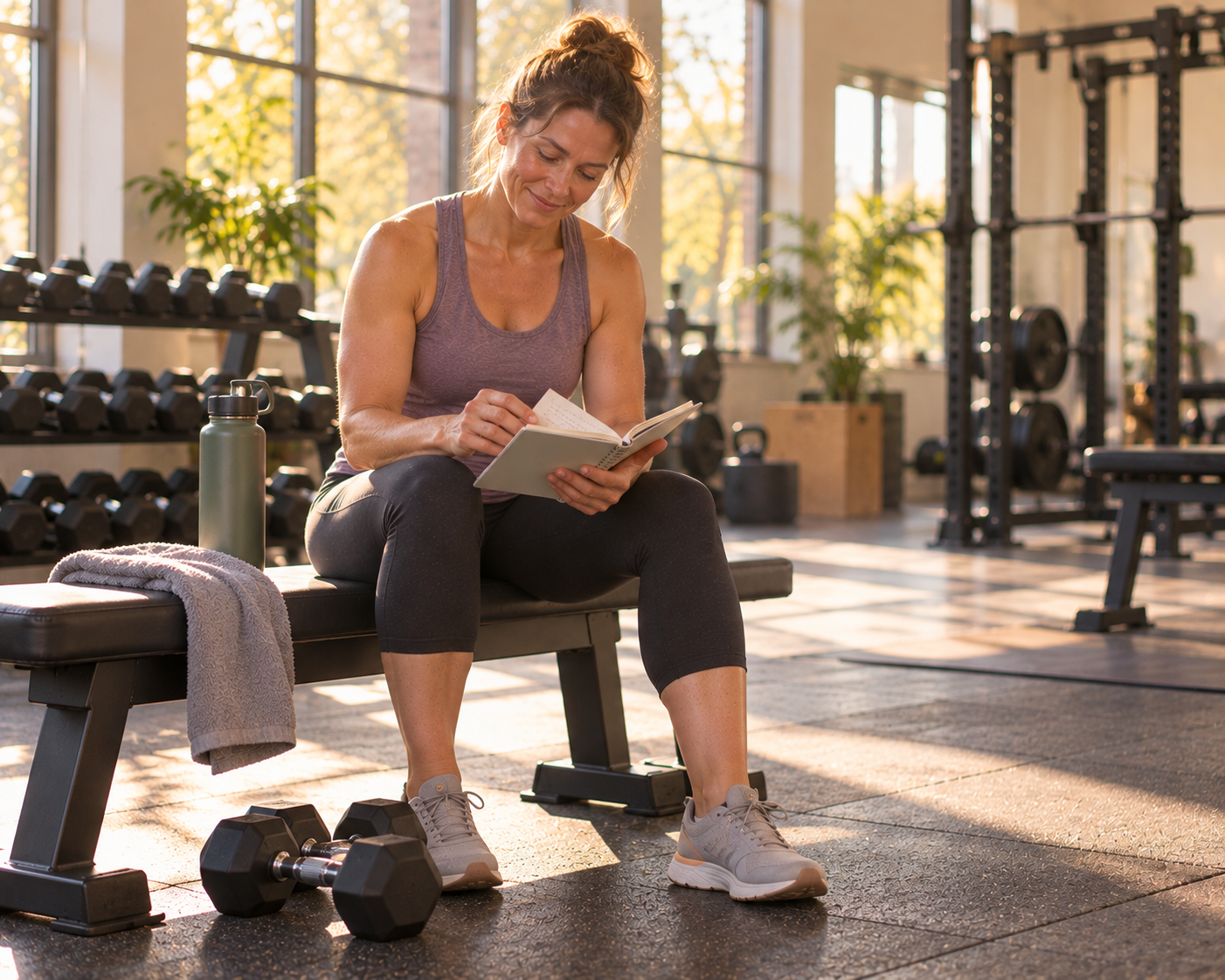
Writing it all down in a notebook like the &And Per Se Fitness Workout Journal works well. So does Health Mentor AI, which logs every set and weight, shows what you lifted last time before you start, syncs resting heart rate from Apple Health or Health Connect, and shows the trend against your own baseline. As we explained in the comparison trap, your own numbers are the only ones that matter.
What should you eat to support weight training?
Prioritise protein at every meal, eat enough overall to recover, and keep sleep consistent. Most active adults do well on roughly 1.2–1.6 g of protein per kilogram of body weight per day, spread across three or four meals.
That's a palm-to-hand-sized portion of protein per meal: eggs, Greek yoghurt, chicken, fish, lean beef, tofu, beans or lentils. It needn't be expensive, as we show in protein on a budget. If you also want to lose fat, a modest calorie deficit works well alongside lifting, but avoid crash diets, which make it much harder to hold on to the muscle you're working to build.
Is it too late to start lifting in your 40s or 50s?
No. Muscle and strength respond to training at every age, and the people who arguably benefit most are those starting later. Strength declines faster than muscle size with age, so building it now creates a reserve that pays off for decades.
Start with the same plan, progress a little more gradually, and give recovery a bit more attention. If you have joint pain, a back problem or a medical condition, get advice from your GP or a physiotherapist first. Resistance training is often part of the recommendation rather than something to avoid, as our article on arthritis and strength training explains.
If you'd rather have the plan built for you, Health Mentor AI can create a weekly workout plan around your goals, equipment and schedule, track every session, and its AI mentor can suggest swaps when a machine is taken or an exercise doesn't suit you. Get the app and book your first session for this week.
Frequently Asked Questions
Is it too late to start weight training at 40 or 50?
No. Muscle and strength respond to resistance training at every age, and people who start later often have the most to gain because strength declines faster than muscle size as we get older. Start with two full-body sessions a week, progress gradually, and get advice first if you have a joint problem or medical condition.
How many days a week should a beginner man lift weights?
Two full-body sessions a week is an ideal start, with at least one rest day between them. Each session takes around 40 to 45 minutes. After a month or two you can add a third session. A meta-analysis of cohort studies found the greatest health benefits at around 30 to 60 minutes of muscle-strengthening activity per week.
Can weight training lower blood pressure?
Yes. A network meta-analysis of 270 randomised trials found dynamic resistance training lowered resting blood pressure by around 4.6/3.0 mmHg, similar to aerobic exercise. Isometric exercises such as wall sits and planks produced the largest reductions, at around 8.2/4.0 mmHg. Check with your GP first if you have high blood pressure or a heart condition.
Why does grip strength matter for health?
Grip strength is a simple marker of overall muscular strength. In the PURE study of nearly 140,000 adults across 17 countries, every 5 kg lower grip strength was associated with a 16% higher risk of death from any cause, and grip strength predicted death more strongly than systolic blood pressure. Getting stronger overall is the best way to improve it.
Is a full-body routine or a body-part split better for beginners?
For most beginners a full-body routine two or three times a week works best. It trains each muscle group at least twice a week, keeps sessions shorter, and makes it easier to practise the main movements frequently. Splits that train each muscle once a week can work later, but they are less forgiving if you miss a session.
Scientific References
- Leong et al. (2015), The Lancet — Prognostic value of grip strength: findings from the Prospective Urban Rural Epidemiology (PURE) study
- Edwards et al. (2023), British Journal of Sports Medicine — Exercise training and resting blood pressure: a large-scale pairwise and network meta-analysis of randomised controlled trials
- Momma et al. (2022), British Journal of Sports Medicine — Muscle-strengthening activities are associated with lower risk and mortality in major non-communicable diseases: a systematic review and meta-analysis of cohort studies
- Phillips et al. (2026), Medicine & Science in Sports & Exercise — Resistance training prescription for muscle function, hypertrophy, and physical performance in healthy adults: an overview of reviews
Products Mentioned in This Article
You don't need any of these to start if you have a gym membership. They're useful for measuring and recording the progress you'll make.
CAMRY Digital Hand Dynamometer
An inexpensive digital grip strength meter, the same kind of measure used in the large PURE study. Test both hands at the start of the programme and again at week 12 for an objective, motivating benchmark of overall strength.
View on Amazon →&And Per Se Fitness Workout Journal (A5, Black)
An undated hardback log for recording every exercise, set and weight. Double progression only works when you know exactly what you did last time, and a notebook in your gym bag makes sure you always do.
View on Amazon →As an Amazon Associate, we earn from qualifying purchases. This comes at no additional cost to you.