
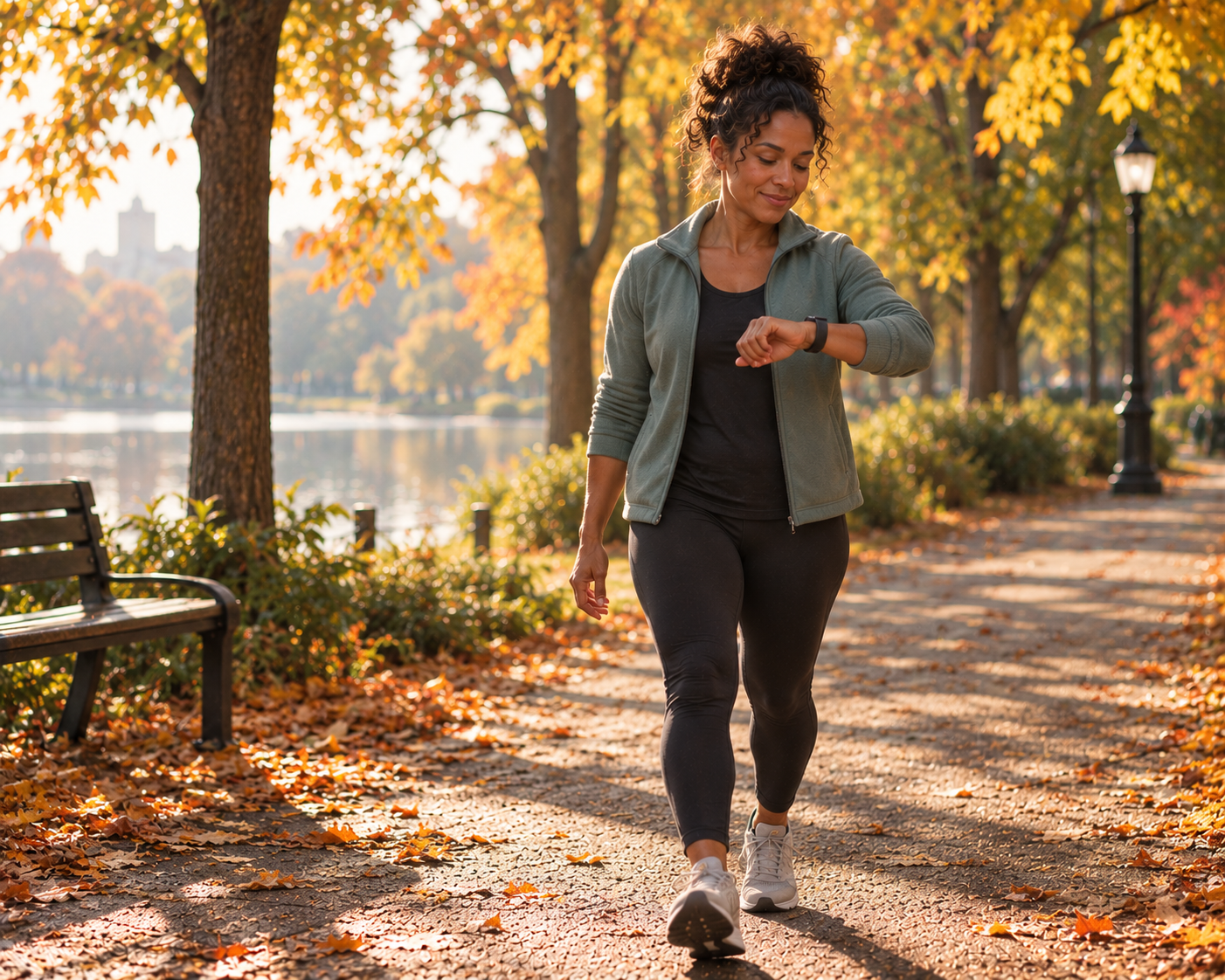
It's half past nine at night. Your watch says 6,412 steps, and there's a small, nagging voice telling you the day doesn't count unless you hit 10,000. So you pace the kitchen, or walk laps of the living room while the kettle boils, or give up and feel vaguely guilty about it.
Here's the good news: that 10,000 figure was never based on research. When scientists finally tested how many steps a day people actually need, the answer turned out to be lower, more forgiving and far more interesting. This guide covers what the large studies found, how the answer changes with age, and how to use your step count as a tool rather than a daily verdict.
Where does the 10,000 steps a day target come from?
From marketing. In 1965 the Japanese company Yamasa Tokei Keiki launched a pedometer called the manpo-kei, which translates roughly as "10,000-step meter". It was a catchy round number, not the result of a study, and it stuck for six decades.
That doesn't make 10,000 steps a bad goal. It's simply that the number wasn't chosen because of any health threshold, and for many people it's an all-or-nothing target that makes a perfectly good 7,000-step day feel like a failure. The research now gives us something better.
How many steps a day do you really need?
For most adults, around 7,000 steps a day captures the bulk of the health benefit. A 2025 meta-analysis of 57 studies found that 7,000 steps was linked to a 47% lower risk of early death compared with 2,000 steps, and that mortality benefits beyond 7,000 steps were small.
The analysis, published in The Lancet Public Health, looked across eight major health outcomes. Walking around 7,000 steps a day was also associated with a 38% lower risk of dementia compared with 2,000 steps, alongside lower rates of cardiovascular disease and depressive symptoms. The researchers found that going from 7,000 to 10,000 steps added only modest extra benefit for most outcomes, although a few, such as type 2 diabetes risk, kept improving at higher counts.
Key insight: 10,000 steps isn't wrong. It's just not the threshold. Most of the benefit is already banked by 7,000, so a "short" day is still doing a lot of good.
Is there a minimum number of steps that makes a difference?
Yes, and it's lower than most people expect. In a meta-analysis of 111,309 adults, the risk of death began to fall significantly at around 2,500 steps a day, and cardiovascular risk at around 2,700. Benefits kept accumulating up to roughly 8,800 steps for mortality and 7,100 for cardiovascular events.
That study, published in the Journal of the American College of Cardiology, pooled 12 studies that measured steps objectively with wearable devices rather than relying on memory. The practical message is encouraging for anyone starting from a low base: you don't need to leap to 10,000. Each extra thousand steps from a low starting point is where the biggest gains are.
If your current average is 3,000, getting to 5,000 is a genuinely meaningful health change. If you're at 6,000, getting to 8,000 helps too. The curve is steepest at the bottom.
Does the number of steps you need change with age?
Yes. The benefit levels off sooner as you get older. In a meta-analysis of 15 international cohorts, the reduction in mortality risk plateaued at around 6,000–8,000 steps a day for adults aged 60 and over, and at around 8,000–10,000 steps for adults under 60.
The study, published in The Lancet Public Health, followed 47,471 adults for a median of seven years. People in the highest step group (averaging nearly 11,000 a day) had about half the risk of death of those in the lowest group (averaging around 3,500). Older adults saw a slightly larger relative benefit than younger ones.
Similar results came from the Women's Health Study, reported in JAMA Internal Medicine. In 16,741 women with an average age of 72, around 4,400 steps a day was linked to significantly lower mortality than around 2,700, with benefits levelling off at about 7,500 steps.
👟 Rough step targets from the research
- Starting pointAround 2,500–4,000 steps a day is where measurable benefits begin. If you're below this, every extra walk counts.
- Most adultsAround 7,000 steps a day captures most of the mortality benefit.
- Under 60Benefits continue to roughly 8,000–10,000 steps before levelling off.
- 60 and overBenefits level off at around 6,000–8,000 steps.
These are ranges from observational research, so they show strong associations rather than proof that the steps themselves cause every benefit. But the consistency across very large studies is reassuring.
Does walking speed matter, or just the number of steps?
Total steps matter most, though a brisker pace may add a little. The evidence on speed is mixed: some studies find extra benefit from a faster cadence, while others find that once total steps are accounted for, speed adds little.
In the Women's Health Study, stepping intensity wasn't clearly linked to lower mortality after total steps were taken into account. The cardiology meta-analysis, by contrast, found that people walking at a moderate or brisk cadence had around a 20% lower risk of death than those walking slowly. The fair summary: get the steps first, and if you can walk briskly for some of them, that's a bonus rather than a requirement.
What about if you already exercise?
Steps still matter, because they measure something your workout doesn't: how much you move during the rest of the day. An hour at the gym followed by ten hours of sitting is a very different day from the same hour plus regular walking.
We explored this in the desk-bound athlete, which covers how training and daily sitting act as separate exposures. Steps are the easiest way to keep an eye on the non-gym part of your day. They also count as genuine aerobic activity: a brisk walk is low-intensity cardio, which we cover in our guide to Zone 2 training.
How can you get more steps without trying very hard?
Attach walking to things you already do. Most people find steps through small, repeatable habits rather than one long walk, and a few minutes here and there add up to thousands by bedtime.
- Walk your calls. Phone calls are the easiest steps of the day. Stand up and pace, or take them outside.
- The 10-minute after-meal walk. Three short walks after meals can add 3,000 steps or more, and also help blunt the rise in blood sugar after eating.
- Park further away or get off the bus a stop early. Small, but daily.
- Make one coffee a walking coffee. Walk to get it instead of making it at your desk.
- Walk with someone. A friend, a partner or the dog. Social walks tend to be longer and more likely to happen.
- Use the stairs whenever it's one or two floors.
Rather than fixating on a single day, look at your weekly average. A 4,000-step Sunday on the sofa doesn't cancel out a week of 8,000-step days. It's the long-run pattern that the research is measuring.
How should you track your steps?
Use whatever already counts them, and watch the weekly average rather than the daily number. Your phone counts steps whenever it's in your pocket, and a watch or fitness band counts them all day. Either is accurate enough to show your trend.
If you'd like something on your wrist, a simple band such as the Fitbit Inspire 3 counts steps and also records resting heart rate and sleep, without the cost of a full smartwatch.
The real value comes from seeing your steps in context. Health Mentor AI syncs with Apple Health and Health Connect, so the activity your phone or watch already records sits in the same place as your workouts, food and sleep, and feeds into your health picture over time. You can even ask the AI mentor how this month's activity compares with last month's, and get a straight answer from your own data.
So what's the right number for you?
Start from your own baseline. Look at your average daily steps over the last two weeks, then aim to add 1,000–2,000 to it. If you're well below 5,000, that's where the biggest gains are. If you're already around 7,000–8,000, you've captured most of the benefit, and adding strength training or some brisker walking is probably a better next step than chasing 10,000.
The point isn't to hit a magic number. It's to move a little more than you did last month, most days, for years. Get the app and see what your real average is. It might be better than you think.
Frequently Asked Questions
How many steps a day do you really need?
For most adults, around 7,000 steps a day captures the bulk of the health benefit. A 2025 meta-analysis of 57 studies found 7,000 steps was linked to a 47% lower risk of early death compared with 2,000 steps, with only modest extra benefit for most outcomes beyond that. Benefits begin at much lower counts, from around 2,500 steps a day.
Is 10,000 steps a day necessary?
No. The 10,000 figure comes from the name of a 1965 Japanese pedometer, the manpo-kei, rather than from research. Large studies show that mortality benefits level off at around 6,000 to 8,000 steps for adults over 60 and 8,000 to 10,000 for younger adults. Walking 10,000 steps is still good for you; it just isn't a threshold.
How many steps a day should older adults aim for?
For adults aged 60 and over, the reduction in mortality risk levelled off at around 6,000 to 8,000 steps a day in a meta-analysis of 15 cohorts. In a study of women with an average age of 72, around 4,400 steps a day was already linked to significantly lower mortality than 2,700, with benefits plateauing at about 7,500.
Does walking faster matter more than the number of steps?
Total steps matter most. Some studies find extra benefit from walking at a brisk cadence, while others find little added effect once total daily steps are accounted for. The practical approach is to build up your daily steps first and walk briskly for some of them where you can.
Do steps still matter if I go to the gym?
Yes. Steps reflect how much you move during the rest of the day, which is a separate exposure from a workout. An hour of training followed by long periods of sitting is different from the same session plus regular walking, so tracking steps helps you keep an eye on the non-gym part of your day.
Scientific References
- Ding et al. (2025), The Lancet Public Health — Daily steps and health outcomes in adults: a systematic review and dose-response meta-analysis
- Stens et al. (2023), Journal of the American College of Cardiology — Relationship of daily step counts to all-cause mortality and cardiovascular events
- Paluch et al. (2022), The Lancet Public Health — Daily steps and all-cause mortality: a meta-analysis of 15 international cohorts
- Lee et al. (2019), JAMA Internal Medicine — Association of step volume and intensity with all-cause mortality in older women
Products Mentioned in This Article
Your phone already counts your steps when it's in your pocket. A wrist tracker is useful if you want the whole day counted, including the times your phone is on the desk.
Fitbit Inspire 3 Health & Fitness Tracker
A slim, affordable band that counts steps all day and also tracks resting heart rate and sleep. Battery life is long, so it rarely comes off your wrist. On Android, Fitbit data can be shared through Health Connect.
View on Amazon →As an Amazon Associate, we earn from qualifying purchases. This comes at no additional cost to you.