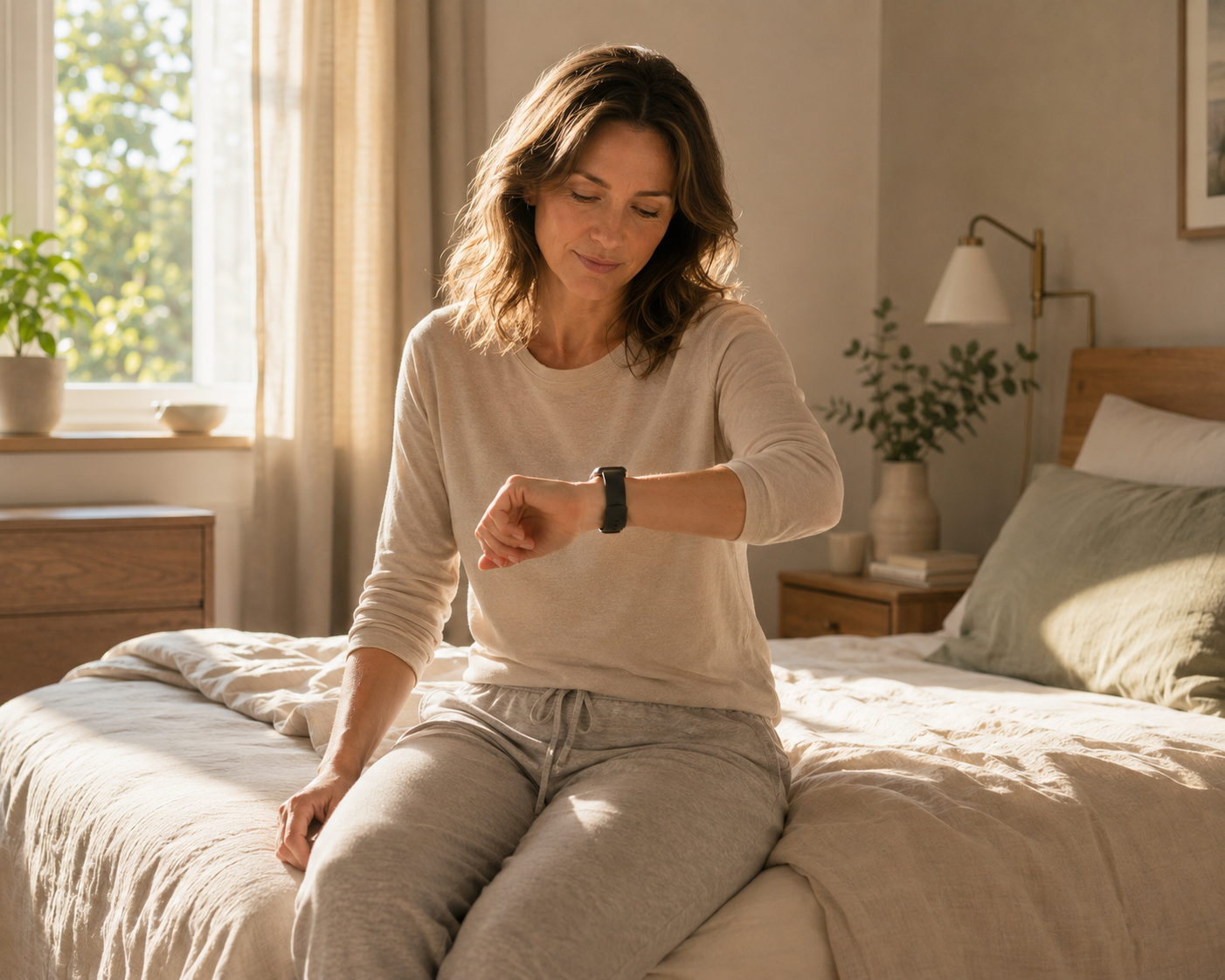

You wake up, the app has already decided something about you, and there it is: 42 today, against 55 yesterday. Amber. "Take it easy." And now you have a problem, because your plan says intervals, you feel fine, and a two-digit number has just cast a vote in a decision it has never explained the reasoning for.
Most HRV writing stops at what the metric is — vagal tone, beat-to-beat variation, the parasympathetic nervous system. That's covered in our explainer on what HRV actually measures. This piece is about the harder question that follows: what should today's number actually change, how confident should you be, and where does the evidence run out?
Does training by HRV beat just following the plan?
Three meta-analyses have asked this, and the honest summary is: modestly, and not in the way the marketing suggests.
One review in the Journal of Science and Medicine in Sport pooled eight studies of 198 participants. HRV-guided training produced a medium positive effect on submaximal physiological markers, but effects on performance and peak oxygen uptake were small and not statistically significant. A second, in the International Journal of Environmental Research and Public Health, found HRV-guided training clearly superior for preserving and improving vagal HRV itself, with consistently small but non-significant advantages for aerobic capacity and endurance performance. A third review focused specifically on VO₂max did find a small significant advantage for the HRV-guided groups.
Two details in that literature matter more than the headline numbers. First, the HRV-guided groups generally performed fewer moderate and high-intensity sessions than the fixed-plan groups — and still matched or slightly beat them. Second, and most consistently, HRV-guided training was associated with fewer people responding badly and more responding well.
Key insight: HRV monitoring isn't a performance enhancer. It's a downside-protection tool — a way of doing less hard work without losing anything, and of catching the weeks where pushing on would have cost you.
Why your number is meaningless (and your trend isn't)
Resting HRV varies enormously between people for reasons that have nothing to do with fitness or recovery: age, genetics, breathing rate, body position, even the device. A 90 and a 35 can both be entirely healthy. Comparing your reading to a friend's, or to a "normal range" table, is like comparing your resting heart rate to someone else's and concluding one of you is broken.
What carries information is change relative to your recent history. This is why serious monitoring uses rolling averages: work with elite endurance athletes published in Sports Medicine found that averaging values over a week was superior to reading any isolated day, and that individual athletes have distinctive HRV fingerprints that only long-term tracking reveals.
That paper also flagged the complication most consumer apps quietly ignore: in highly trained athletes, HRV going up has sometimes accompanied negative adaptation, and fitness gains have occurred alongside HRV going down. The relationship is not a simple one-way dial, and anyone telling you higher is always better is oversimplifying.
How to measure it so the number means something
Most people's HRV data is too noisy to act on, and the cause is almost always inconsistent measurement rather than inconsistent physiology.
📏 The measurement protocol
- Immediately on waking. Before you get up, before caffeine, ideally before you look at your phone — a stressful email genuinely changes the reading.
- Same position every time. Supine or seated, but pick one and never mix them. Position alone can shift the number substantially.
- One to two minutes. Longer isn't better for daily monitoring, and short recordings are what the research protocols mostly use.
- Breathe normally. Don't slow your breathing to game the score. Paced breathing inflates HRV and destroys comparability with your other mornings.
- At least three to five mornings a week. Fewer than that and your rolling average isn't stable enough to interpret.
- One device, consistently. A chest strap is the most reliable. Validated smartphone camera apps have compared acceptably with a chest strap and ECG, but switching between methods makes your history meaningless.
Then give it three to four weeks before you act on anything. You cannot detect a departure from normal until you know what normal looks like.
The actual decision rule
Once you have a 7-day rolling average and a sense of your usual spread, the protocol is simpler than the apps make it look. Note what it mostly does: it changes intensity, not attendance.
🚦 What today's reading should change
- Within normal rangeTrain as planned. This will be most days, and it should be — the metric earns its keep on the exceptions.
- One day below rangeKeep the session, drop the intensity. Do the easy version. A single low value is very often noise, a late meal, or last night's wine rather than genuine fatigue.
- Three or more days belowThis is the real signal. Take three to five easy days — that's the pattern the HRV-guided trials used, and the mechanism by which those groups avoided negative responses.
- Unusually high spikeNot automatically good. A sharp rise alongside heavy accumulated load and declining performance can accompany overreaching. Treat it as a prompt to check your performance data, not to add a session.
- Baseline drifting up over weeksUsually a positive adaptation signal in recreational athletes, especially alongside a falling resting heart rate.
- Range getting widerDay-to-day variability increasing is often more informative than the average moving. It tends to precede the average dropping.
If you take one thing from that table: the difference between "one bad morning" and "three bad mornings" is the entire practical value of the measurement. Everything else is decoration.
Four things that explain most bad mornings
Before rewriting your training block, check the boring explanations. In practice they account for the overwhelming majority of low readings.
- Alcohol. The single biggest acute disruptor for most people. A real-world study of 4,098 employees published in JMIR Mental Health found alcohol disturbed cardiovascular relaxation during the first hours of sleep in a dose-dependent way in both sexes — and that neither being young nor being physically active protected against it.
- Short or broken sleep. Predictably suppresses morning HRV, and is a far more likely explanation than mysterious accumulated fatigue.
- An illness starting. HRV frequently drops a day or two before you feel symptoms. This is one of the metric's genuinely useful early warnings.
- A hard session under 24 hours ago. Post-exercise autonomic suppression is expected and normal. A low reading after yesterday's intervals is the system working, not a problem.
Note that three of those four are things you already knew about when you woke up. Which is a useful reality check on how much extra information the number is really adding on any given day.
Where HRV shouldn't be driving the decision
Three honest limits, because the metric is being applied well beyond where it was tested.
Strength training. Essentially all of the HRV-guided training evidence comes from endurance athletes — runners, cyclists, triathletes. Whether it usefully guides barbell work is largely untested. Local muscular fatigue and soreness aren't well reflected in cardiac autonomic measures.
Beginners. If you're training two or three times a week, you are almost certainly not accumulating the kind of load that HRV monitoring exists to detect. The limiting factor is turning up, not knowing precisely when to back off.
People who'll be made anxious by it. This is the failure mode nobody warns about. A daily score that pronounces on your body's readiness can become something to worry about, chase and feel judged by — at which point the anxiety itself starts suppressing the reading. If you notice the number affecting your mood before it affects your training, that's a reason to stop measuring, not to measure harder.
The version that costs nothing
Before buying anything, try the free version for a month. Each morning, rate three things out of five — sleep quality, muscle soreness, and general energy — and write them down. In a good deal of the monitoring literature, simple subjective wellness scores track training stress about as well as the physiological ones, and one recent trial in trained cyclists compared HRV alone against HRV plus wellbeing scores precisely because the combination looks more informative than either.
They're also complementary rather than competing. HRV catches the illness you haven't noticed yet; your own rating catches the psychological load that a heart-rate metric can miss entirely. Where they agree, act. Where they disagree, do the easy version of the session and see what tomorrow says.
The other reason to log both: the value only appears over months. A single morning's HRV tells you almost nothing, but three months of readings plotted against what you actually trained, how you slept and how sessions felt will show you your own patterns — which nights cost you, which training weeks you tolerate, how long you personally take to bounce back. That's the kind of multi-variable trend Health Mentor AI is built to surface, rather than leaving you to squint at a chart of one metric in isolation.
And if today's reading is amber but you feel good and the plan says intervals? Do the intervals, slightly easier than written. The number gets a vote, not a veto.
Frequently Asked Questions
Does HRV-guided training actually work better than a fixed plan?
Modestly, and not in the way most people expect. Across three meta-analyses the effects on peak performance and VO₂max were small and often not statistically significant. What did show up consistently was fewer people responding badly, better submaximal physiological markers, and better preserved vagal HRV — usually while doing fewer hard sessions than the fixed-plan group.
What is a good HRV number?
There isn't one. Between-person variation is enormous, so comparing your rMSSD to a friend's or to a published average tells you nothing useful. The only meaningful comparison is your own number against your own recent baseline, which is why every credible protocol uses a rolling average rather than an absolute threshold.
Should you skip training if your HRV is low?
Rarely skip — usually adjust. One reading below your normal range is best handled by keeping the session and dropping the intensity, since a single low value is often measurement noise, a late meal or a glass of wine. Three or more consecutive days below your range is the signal that warrants a genuine easy block.
How do you measure morning HRV properly?
Same time, same position, same conditions: immediately on waking, before caffeine, ideally before looking at your phone, one to two minutes of recording, at least three to five mornings a week. A chest strap is the most reliable option, and validated smartphone camera apps have been shown to compare acceptably with a chest strap and ECG.
What causes a sudden drop in morning HRV?
Alcohol is usually the biggest single culprit — a study of 4,098 people found it disturbed cardiovascular recovery during the first hours of sleep in a dose-dependent way in both sexes. Short sleep, the early stages of an illness, a hard session in the previous 24 hours, and simple measurement inconsistency account for most of the rest.
Scientific References
- Düking et al. (2021), Journal of Science and Medicine in Sport — Monitoring and adapting endurance training on the basis of heart rate variability monitored by wearable technologies: a systematic review with meta-analysis
- Manresa-Rocamora et al. (2021), IJERPH — Heart rate variability-guided training for enhancing cardiac-vagal modulation, aerobic fitness, and endurance performance: a methodological systematic review with meta-analysis
- Granero-Gallegos et al. (2020), IJERPH — HRV-based training for improving VO₂max in endurance athletes: a systematic review with meta-analysis
- Plews et al. (2013), Sports Medicine — Training adaptation and heart rate variability in elite endurance athletes: opening the door to effective monitoring
- Pietilä et al. (2018), JMIR Mental Health — Acute effect of alcohol intake on cardiovascular autonomic regulation during the first hours of sleep in a large real-world sample
- Scientific Reports (2025) — Individual training prescribed by heart rate variability, heart rate and well-being scores in experienced cyclists
Products Mentioned in This Article
Measurement consistency matters far more than device price. One strap used the same way every morning beats an expensive device used inconsistently.
Polar H10 Heart Rate Sensor
The chest strap most commonly used as the reference device in HRV research. Records beat-to-beat intervals reliably, pairs with essentially every HRV app, and removes the main source of noise in wrist-based measurement. If you're going to act on the number, measure it properly.
View on Amazon →COOSPO H808S Heart Rate Monitor Chest Strap
A budget Bluetooth and ANT+ strap for anyone wanting to test the habit before committing. Not a research-grade device, but consistent with itself — which, since the only comparison that matters is against your own baseline, is most of what the protocol requires.
View on Amazon →As an Amazon Associate, we earn from qualifying purchases. This comes at no additional cost to you.