Most sleep advice is about behaviour: what time you go to bed, what you drink, how much screen time you had. That matters. But behaviour only gets you to the point of falling asleep — after that, for the next seven or eight hours, you're at the mercy of the room. Temperature, light, sound and air are working on your nervous system continuously, and you're unconscious for the whole experiment.
Deep sleep, or slow-wave sleep, is the stage most sensitive to these conditions. It's also the stage most concentrated in the first half of the night and the one most associated with physical recovery. Get the environment wrong and you don't necessarily wake up — you just spend more of the night in lighter stages and can't work out why eight hours left you flat. Here are the five variables that matter, what the evidence says about each, and where to set them.
1. Temperature: why your room must be cool but your skin must be warm
Falling asleep requires your core body temperature to drop, and it drops by shedding heat through your hands and feet. That's the mechanism that makes temperature the single most influential environmental variable — and it's why a room that's too warm doesn't just feel uncomfortable, it physically blocks the transition into deep sleep.
Reviewing the experimental literature in the Journal of Physiological Anthropology, Okamoto-Mizuno and Mizuno described the stereotypical effects of both heat and cold exposure: increased wakefulness, with reduced REM sleep and reduced slow-wave sleep. Note that it goes both ways. A freezing room isn't better — cold raises metabolic rate and disrupts sleep too.
The subtlety most people miss is the split between room and skin. Your body needs a cool ambient environment to dump heat into, but warm skin — particularly at the hands and feet — is what opens the blood vessels that do the dumping. Research on the temperature dependence of sleep notes that direct skin warming can shorten sleep latency and promote NREM sleep, and that this microclimate effect can't simply be replaced by warming the whole room to the same temperature.
Key insight: Cool room, warm bed, warm feet. Socks in a cold bedroom sound unglamorous and are one of the better-evidenced sleep interventions there is.
Practically: aim for roughly 16–19°C ambient, then adjust bedding until you're neither kicking the duvet off at 2am nor curled up cold. If you wake hot in the small hours, the duvet tog is usually the variable to change before the thermostat.
2. Light: your eyelids are not a blackout blind
Only a small percentage of light penetrates closed eyelids — but it's enough to alter your sleep architecture. This is the variable people most consistently underestimate, because "I sleep fine with the curtains open" is a judgement made by someone who was asleep.
In a controlled laboratory study published in PNAS, participants slept one night in dim light (under 3 lux) and one night under 100 lux of overhead room lighting — roughly typical indoor illumination. On the lit night they spent proportionally more time in stage N2 light sleep and less in slow-wave and REM sleep. Their heart rate was higher and heart rate variability lower throughout the night, indicating a shift towards sympathetic — that is, stress-side — nervous system activity. Melatonin didn't differ significantly between conditions, which makes the sleep-stage effect more interesting, not less: something other than melatonin suppression was doing the work.
Lower levels matter too. A home-based study in International Journal of Environmental Research and Public Health exposed young volunteers to just 1 lux or 5 lux across whole nights. Even 1 lux — dimmer than most standby LEDs at close range — increased sleep fragmentation, while 5 lux reduced melatonin production significantly.
The fix is unglamorous and effective: proper blackout at the window, and an audit of everything in the room that glows. Standby lights, charging indicators, the router, the alarm clock display. Tape over what you can't unplug.
3. Noise: the arousals you sleep through still count
Night-time noise fragments sleep and redistributes time between the stages — typically increasing wake and light stage 1 sleep while decreasing slow-wave and REM sleep — and this happens at levels well below those that wake you up. A review in Noise & Health notes physiological reactions including cortical arousals, body movements and hormonal responses at levels around 33 dB, with awakenings from aircraft noise at levels as low as 48 dB.
The genuinely uncomfortable finding concerns habituation. A polysomnographic study of 72 people across eleven consecutive nights, published in Sleep, found that effects on sleep structure were subtle — largely because arousal thresholds rose within and across nights as people adapted. But cardiac arousals did not habituate. Your brain learns to ignore the road outside. Your heart doesn't.
WHO community noise guidance recommends below about 30 dB(A) inside bedrooms for good quality sleep, with under 40 dB(A) outside bedrooms to avoid adverse health effects. If you live on a main road, that indoor target is not achievable by willpower. Options that actually work: heavy lined curtains, secondary glazing, moving the bed away from the external wall, earplugs, or masking with broadband sound. Masking is a genuine trade-off — you're adding steady sound to hide variable sound — but a constant hum is far less arousing than an intermittent bang.
4. Air quality: the variable nobody measures
Shut a bedroom door and close the window, and CO2 from your own breathing accumulates through the night — often to levels well above 2,000 ppm, and this is more common in well-sealed modern homes than draughty old ones. It's the one bedroom variable most people have never even considered checking.
Two field experiments in single-occupancy student bedrooms, reported in Indoor Air, changed ventilation either by opening a window or by running a silent intake fan. Average overnight CO2 shifted from around 2,400–2,600 ppm to roughly 660–840 ppm. In the lower-CO2 condition, objectively measured sleep quality improved significantly, as did perceived air freshness, next-day sleepiness, ability to concentrate, and performance on a test of logical thinking. Sleep latency improved with the window open — people fell asleep faster.
These were small studies and later work has found the next-day performance effects less consistent, so treat the size of the effect with appropriate caution. But the direction is consistent, and the intervention is free: open the window, or leave the bedroom door ajar. If you're the sort of person who wants the number, a CO2 monitor will tell you within one night whether you have a problem.
5. The bed itself: your actual microclimate
The temperature that governs your sleep isn't the one on the thermostat — it's the one in the few centimetres between you and your bedding, and that's a variable you control with fabric rather than heating. Research on bedding microclimates puts the skin-surface temperature that supports good sleep in the region of 31–35°C, generated by exactly the "nest-building" behaviour every mammal performs before sleeping.
This is why two people can find the same room unbearable and perfect. It's also why the bedding is often the cheaper fix. Breathable natural fibres move moisture away better than synthetics, which matters because humid heat is more disruptive to sleep than dry heat at the same temperature. Two duvets on a shared bed solves more thermal arguments than any single compromise tog rating will.
😐 The average bedroom
21°C with the heating on a timer, streetlight through thin curtains, phone charging on the nightstand, door and window shut, CO2 climbing past 2,000 ppm by 3am, traffic outside. Eight hours in bed, most of it light.
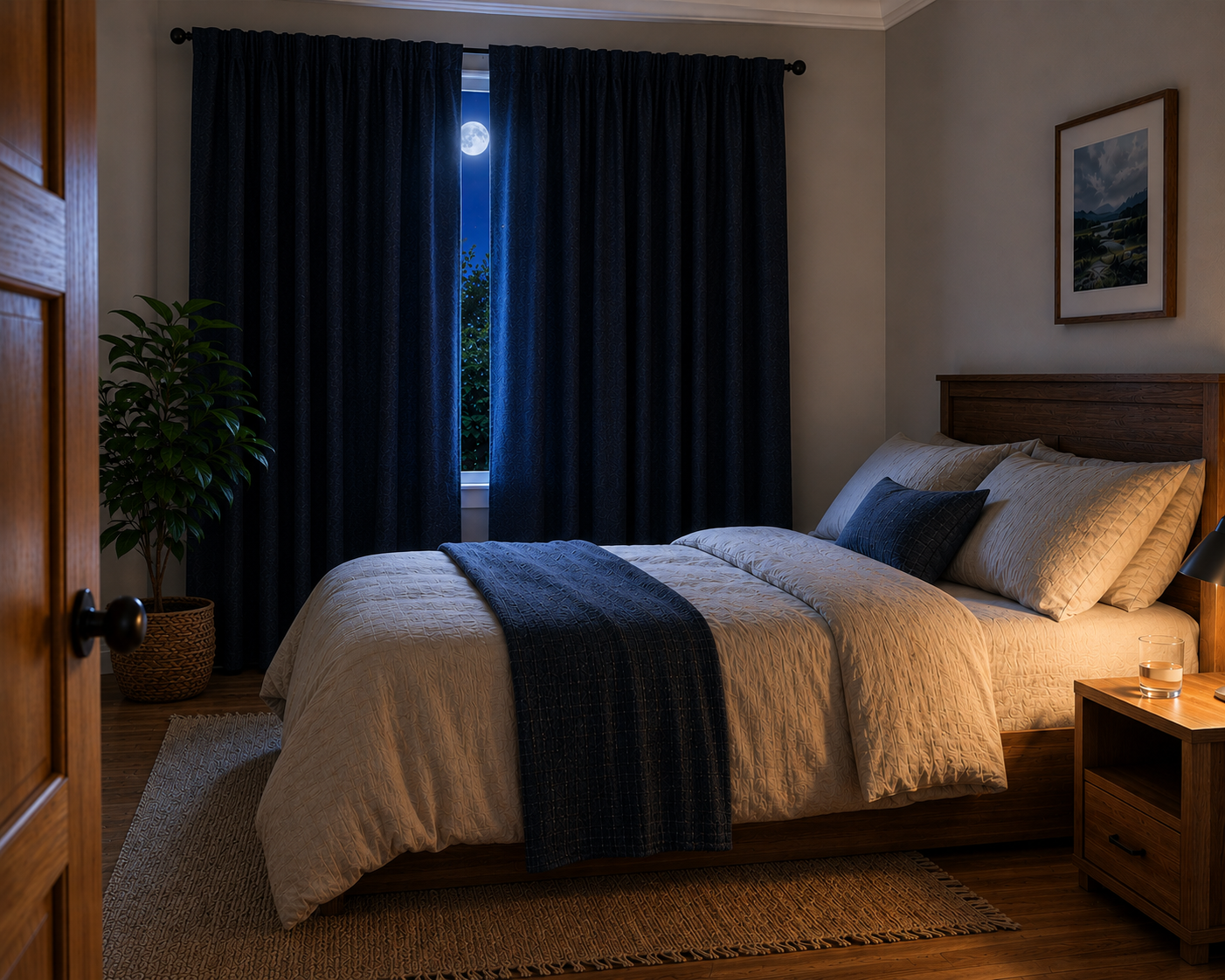
🌙 The tuned bedroom
17°C, blackout at the window, nothing glowing, window on the vent latch or door ajar, steady low masking sound, bedding matched to the season. Same eight hours — a different night's physiology.
Where should you actually set everything?
Targets are useful as a starting point, provided you treat them as a hypothesis to test rather than a rule. Here's a reasonable set to begin from:
🎯 Starting targets
- Temperature~16–19°C ambient — then adjust bedding, not the thermostat
- LightAs close to 0 lux as you can get — blackout blind plus an audit of every LED
- NoiseUnder ~30 dB(A) indoors — WHO guidance; mask what you can't block
- CO2Under ~1,000 ppm overnight — usually just means air can get in
- HumidityRoughly 40–60% — humid heat disrupts sleep more than dry heat
And the practical kit, in order of how much difference it tends to make per pound spent:
- Block the light first. It's the cheapest big lever. A pair of NICETOWN Thermal Insulated 100% Blackout Curtains handles the window and adds a little thermal and acoustic buffering at the same time. Check the size options against your window before ordering.
- Then deal with sound. If your disruption is intermittent — traffic, neighbours, a snoring partner — masking usually beats trying to block. A mechanical unit like the Yogasleep Dohm Classic produces genuine fan-based noise rather than a looping recording, which avoids the subtle repetition your brain can latch onto.
- Then measure the air. This is the variable you're most likely to be wrong about. An Aranet4 Home monitor reports CO2, temperature and humidity together — three of the five variables above — and one night of data tells you whether ventilation is a real problem in your room or something you can stop worrying about.
- Fix the free things. Door ajar, window on the vent latch, phone out of the room, socks on cold nights. None of that costs anything.
How to test your own room
Change one variable at a time, hold it for a week, and judge on the pattern rather than any single night. This is the part people skip, and it's why so many bedroom upgrades get abandoned as "didn't work" — one poor night after buying blackout curtains proves nothing at all.
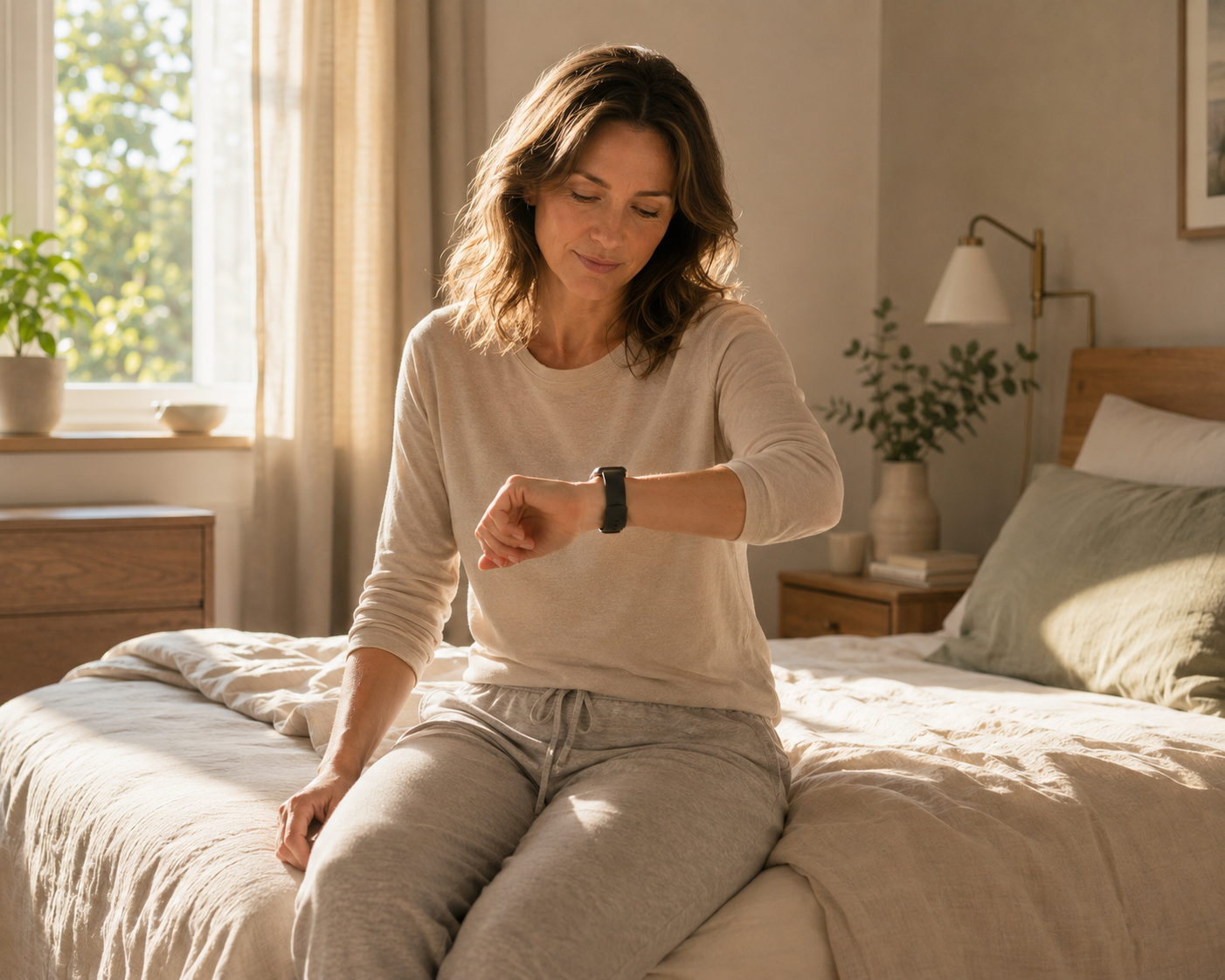
What to watch for: how long it takes to fall asleep, how often you surface in the night, and how you feel in the first hour after waking. That last one is often the most honest signal. If you're using a wearable, deep sleep duration is a reasonable metric to follow across weeks, but consumer devices estimate sleep stages rather than measure them, so trust the trend rather than any single night's number.
Logging the room alongside how you slept is what turns this from guesswork into something you can act on. It's exactly the kind of multi-variable pattern Health Mentor AI is designed to surface — connecting what changed in your environment to your sleep, energy and recovery over weeks rather than leaving you to remember it. And since the environment is only half the picture, it pairs naturally with the behavioural side: our guides to caffeine timing and your sleep cut-off and how your morning sets up the whole day's energy cover what happens either side of the night itself.
One closing caveat worth taking seriously: if you've optimised the room properly and you're still waking unrefreshed, snoring heavily, or feeling sleepy through the day, that's not an environment problem. Persistent unrefreshing sleep is worth discussing with a doctor — conditions like sleep apnoea are common, treatable, and won't be fixed by better curtains.
Frequently Asked Questions
What is the best bedroom temperature for deep sleep?
Most guidance points to roughly 16 to 19°C, though the right figure depends heavily on your bedding. Both heat and cold exposure reduce slow-wave sleep and REM sleep while increasing wakefulness, so the goal is a room cool enough to let your core temperature fall, with bedding warm enough that you never feel cold.
Does light affect sleep even with your eyes closed?
Yes. In a controlled study, a single night of sleeping under 100 lux room lighting shifted sleep architecture — participants spent more time in light N2 sleep and less in slow-wave and REM sleep, with higher heart rate through the night. Only a small fraction of light passes through closed eyelids, but it is enough to matter.
How quiet does a bedroom need to be?
WHO community noise guidance recommends below about 30 dB inside bedrooms for good quality sleep. Nocturnal noise tends to fragment sleep and redistribute time between stages, increasing wake and light sleep while reducing slow-wave and REM sleep — and cardiac arousals do not fully habituate over time.
Does bedroom air quality affect sleep?
It appears to. In field experiments in student bedrooms, reducing CO2 from roughly 2400 ppm to around 800 ppm through better ventilation improved objectively measured sleep quality, perceived air freshness, next-day sleepiness and performance on a logical thinking test. A closed door and closed window can push a bedroom well above 2000 ppm overnight.
Scientific References
- Okamoto-Mizuno & Mizuno (2012), Journal of Physiological Anthropology — Effects of thermal environment on sleep and circadian rhythm
- Mason et al. (2022), PNAS — Light exposure during sleep impairs cardiometabolic function
- Impact of dim light at night on urinary 6-sulphatoxymelatonin concentrations and sleep in healthy humans
- Basner et al. (2011), Sleep — Single and combined effects of air, road, and rail traffic noise on sleep and recuperation
- Halperin, Noise & Health — Environmental noise and sleep disturbances: a threat to health?
- Strøm-Tejsen et al. (2016), Indoor Air — The effects of bedroom air quality on sleep and next-day performance
- Harding et al., Frontiers in Neuroscience — The temperature dependence of sleep
Products Mentioned in This Article
These products were referenced throughout the article to help you control your bedroom environment.
NICETOWN Thermal Insulated 100% Blackout Curtains
Full light blocking with a black lining, plus a useful side effect: the thermal layer buffers temperature swings and takes a little edge off outside noise. The cheapest intervention with the largest likely effect. Multiple sizes available — measure your window first.
View on Amazon →Yogasleep Dohm Classic White Noise Machine
Generates sound mechanically with a real fan rather than looping a recording, so there's no repeating pattern for your brain to track. Two speeds and an adjustable collar let you tune the tone to mask whatever is actually disturbing you.
View on Amazon →Aranet4 Home Indoor Air Quality Monitor
Measures CO2, temperature and humidity — three of the five variables in this article — with an NDIR sensor and up to four years of battery life. One night of overnight data tells you whether your bedroom ventilation is genuinely a problem. Not cheap, but it answers a question you can't answer any other way.
View on Amazon →As an Amazon Associate, we earn from qualifying purchases. This comes at no additional cost to you.