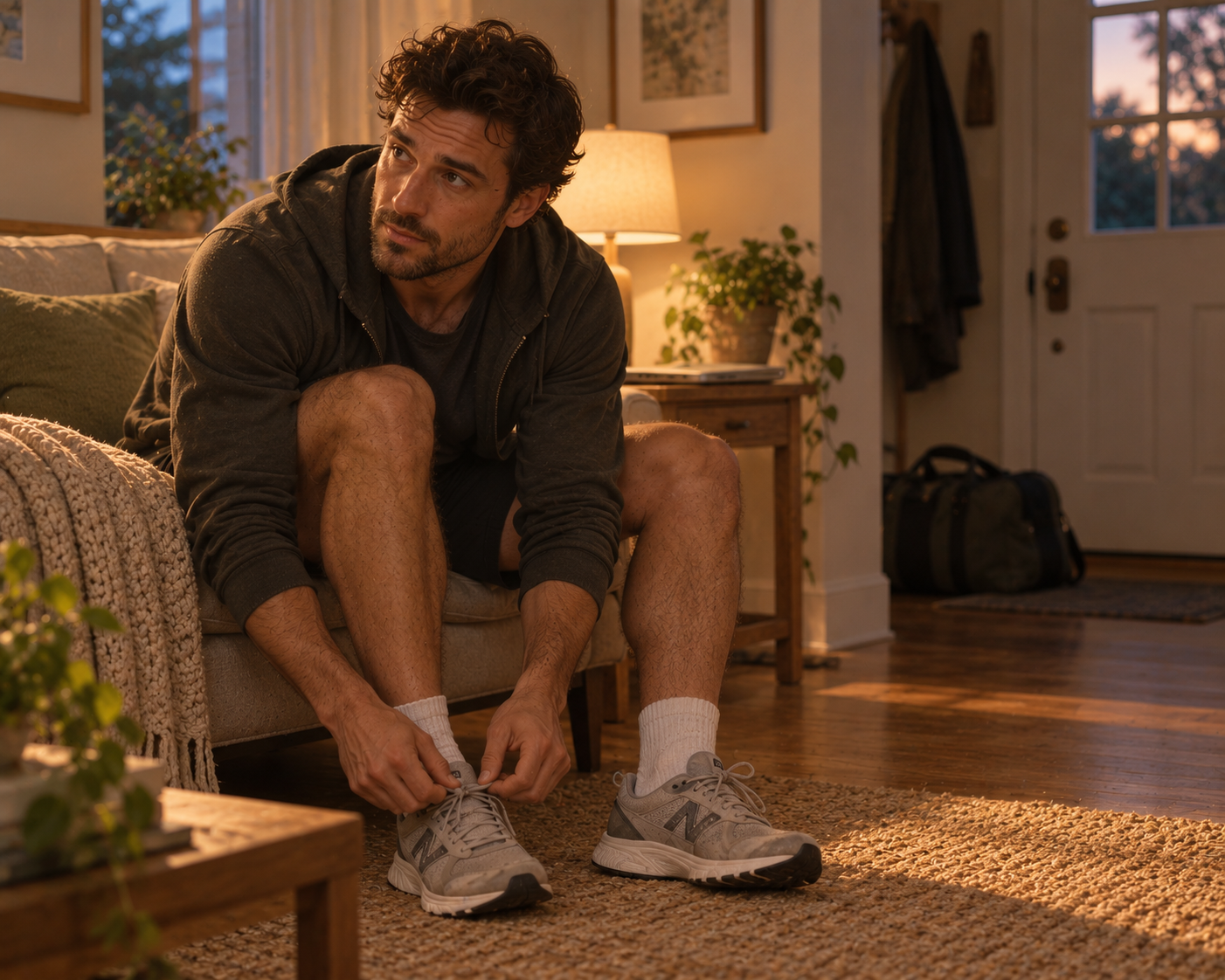
Search "morning routine" and you'll find schedules that take ninety minutes and involve journaling, meditation, cold plunges, affirmations, oil pulling and a green smoothie. They're presented as a package, as though the whole stack has been tested and validated together. It hasn't. Some elements have solid physiology behind them, some have one modest trial, and some have nothing but the confidence of the person recommending them.
The useful question isn't "what do successful people do before 6am?" It's "which of these things has a mechanism, and how little of it can I get away with?" That's the protocol below: ten minutes, three components, ranked honestly by how much evidence sits behind each one.
Minutes 1–10: get outside
This is the one that matters, and if you only do this you've captured most of the available benefit. Light is the primary signal your circadian clock uses to know what time it is, and morning light in particular pulls your body clock earlier — which is what makes you sleepy at a sensible hour that night.
The reason it has to be outdoors is a matter of scale that most people badly underestimate. Your eyes adapt so well that a bright office and a cloudy street feel similarly lit. They aren't.
💡 Light intensity, roughly
- Dim indoor room~100 lux — essentially night-time as far as your clock is concerned
- Bright office~300–500 lux — feels bright, isn't
- Overcast outdoors~1,000–2,000 lux — still several times any indoor setting
- Therapy lampup to 10,000 lux — a genuine substitute when outdoors isn't possible
- Direct sunlighttens of thousands of lux — never look directly at the sun
A grey Welsh morning in November still delivers many times more light than your kitchen with every bulb on. That's the whole argument for stepping outside rather than sitting by the window — and glass cuts a meaningful amount too.
On timing, research on light and the circadian system consistently finds that light exposure in the morning advances the clock while evening light delays it. Ten minutes is a sensible practical floor on a bright morning; extend it when it's dull. Consistency matters more than precision — the same rough time each day beats an occasional perfect hour.
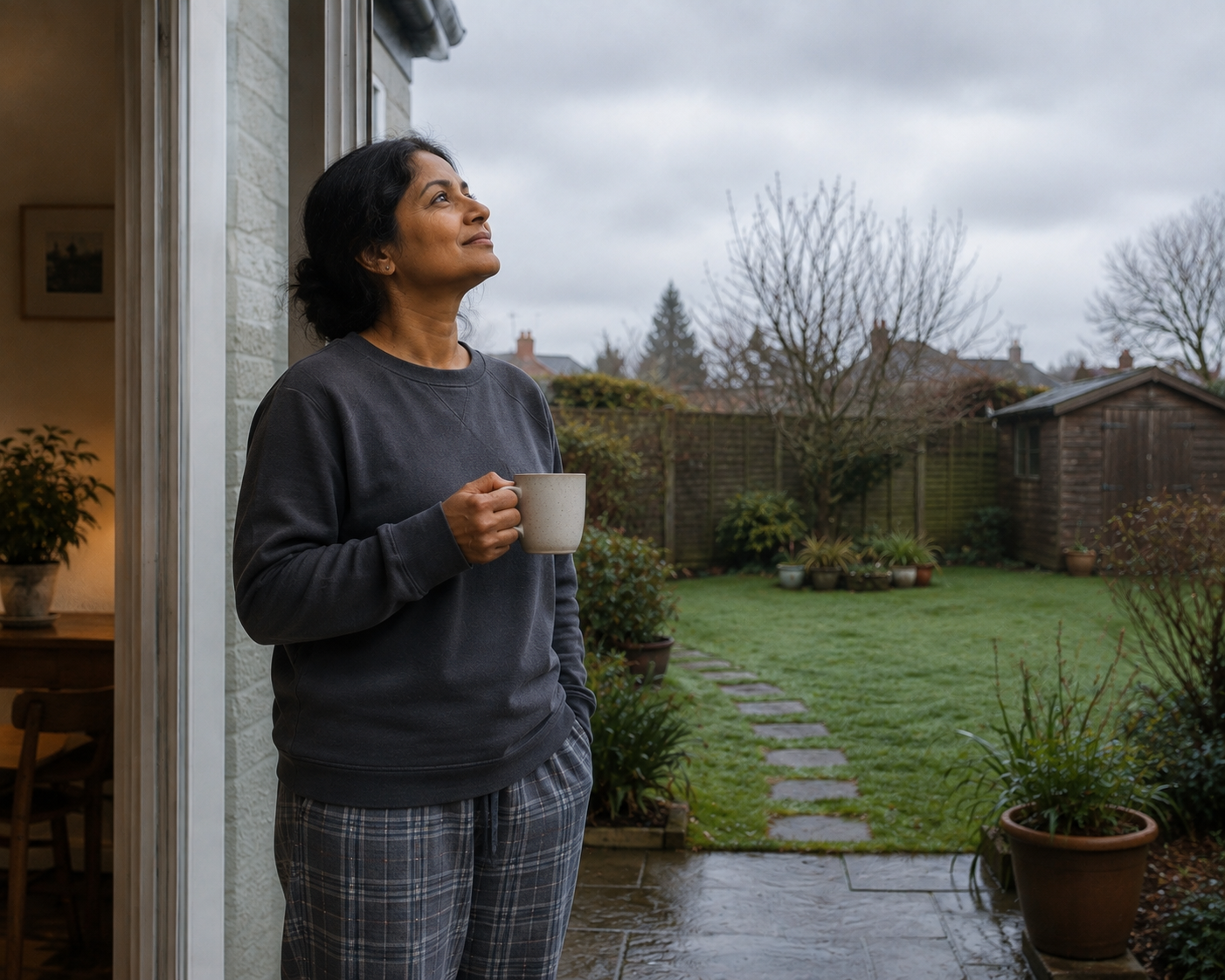
Key insight: Combine it with something you already do. Drink your first coffee on the doorstep. Walk to get a paper. Take the bins out slowly. The point is the light, not the ceremony.
Layer in movement, because it's free
Making those ten minutes a walk rather than standing still costs nothing and adds a second layer of benefit — muscle contraction, a gentle rise in body temperature, and the momentum effect of having already done something.
This is where the honest evidence tiering matters. There's no trial showing that "ten minutes of walking in daylight" specifically optimises a day. What there is: strong evidence that light entrains circadian rhythm, strong evidence that regular physical activity improves nearly everything, and a well-documented behavioural effect where a small completed action makes the next one easier — which we covered in the 3-minute rule.
Stack those three and you have a defensible ten minutes. That's a different claim from "this protocol has been tested", and it's worth being clear about which one you're being sold.
The 30 seconds at the end of your shower
Cold exposure is the one popular morning habit with a genuinely large randomised trial behind it — and the result is more interesting than either the evangelists or the sceptics usually admit.
Buijze and colleagues, publishing in PLOS ONE, randomised 3,018 adults to finish their normal shower with 30, 60 or 90 seconds of cold water, or to shower as usual, for 30 consecutive days. The cold groups showed a 29% reduction in self-reported sickness absence from work.
Two caveats that matter. First, there was no significant difference in the number of illness days — people got ill just as often, they just took less time off, which the authors suggested reflects symptom intensity rather than infection rates. Second, sickness absence was self-reported, and participants obviously knew which group they were in.
The genuinely useful finding: 30 seconds worked as well as 90. There is no benefit to suffering longer. And notably, the same paper found regular physical activity produced a larger reduction in sickness absence than cold showering did — so if you're choosing where to spend your effort, the walk beats the cold.
What to be sceptical about
Not everything in the standard morning-routine stack has comparable support, and treating it all as equivalent is how people end up with a ninety-minute ritual they abandon in week three.
✅ Solid mechanism
Daylight exposure — well-established circadian entrainment. Movement — broad, robust benefits. Cold, briefly — one large RCT, modest and self-reported outcome.
⚠️ Weaker or contested
Delaying coffee 90 minutes — plausible mechanism, thin direct evidence. Affirmations — mixed, and can backfire for people with low self-esteem. Elaborate journaling — real but modest effects, and rarely tested as a morning-specific practice.
None of that means the weaker items are worthless. If gratitude journaling makes your mornings better, keep doing it — you're the relevant evidence. But it does mean you shouldn't feel you've failed a protocol by skipping them, and it means the first things to cut on a chaotic morning are the ones in the right-hand column.
Why ten minutes and not sixty
Because a routine that requires an hour is a routine you abandon the first week something goes wrong — and morning routines fail on adherence, not on design.
Long routines have a second problem: they usually require waking earlier, and if that comes out of sleep rather than out of scrolling, you've made a bad trade. Cutting sleep to fit in a wellness routine is the most self-defeating move in this entire area. A ten-minute protocol fits into the morning you already have.
There's also the reset problem. A routine with nine components fails visibly — you did six of them and it feels like a failure, which is exactly the all-or-nothing trap we covered in why you keep starting over every Monday. A routine with one non-negotiable component either happened or it didn't, and it usually happened.
The realistic version
Here's the whole thing, in the order it actually works:
- Get up when the alarm goes. This isn't part of the ten minutes, but the fragmented snoozing that precedes a rushed morning undoes most of what follows — see the snooze button spiral. If dark mornings are the obstacle, a sunrise alarm like the Philips SmartSleep Wake-Up Light brings the light up gradually before the sound.
- Outside, ten minutes, walking if possible. Coffee in hand is fine. Phone in pocket is better than phone in hand, but light hitting your eyes is what counts.
- Water before caffeine. You've had nothing for seven or eight hours. It takes five seconds.
- Thirty seconds cold at the end of the shower. Optional. No benefit to going longer than 30 seconds.
- Protein at your first meal. Not part of the ten minutes, but it determines how the next four hours feel — the mechanism is in why your afternoon crash starts at breakfast.
If you're in a dark winter, working shifts, or physically can't get outdoors in the morning, a 10,000 lux therapy lamp such as the Verilux HappyLight Luxe is a reasonable substitute — use it while eating breakfast rather than as another task to schedule.
Worth checking first: bright light therapy isn't right for everyone. If you have an eye condition, bipolar disorder, or take medication that increases light sensitivity, speak to your doctor before using a light box. And if low mood is persistent rather than seasonal and mild, that's a GP conversation rather than a lamp purchase.
Testing whether it works for you
Give it three weeks before judging, because circadian shifts are gradual and the effect you're looking for arrives at the wrong end of the day.
The signal isn't how energised you feel at 8am — that's mostly sleep inertia doing its thing regardless. It's whether you feel naturally sleepy at a reasonable hour that evening, whether waking gets easier, and whether the 3pm dip softens. Those are the downstream effects of a better-anchored clock, and they take a fortnight or so to show up.
Logging when you got outside alongside your sleep timing and afternoon energy is what turns "I think it helps" into something you can actually see — which is what Health Mentor AI is built for. Three weeks of that data settles the question far better than three weeks of trying to remember.
And the honest framing to keep: no ten minutes optimises an entire day. What this does is set one signal correctly at the point it matters most, and put a small win on the board before anything has had a chance to go wrong. That's a modest claim — and unlike most morning routine advice, it's one the evidence will actually support.
Frequently Asked Questions
What is the single most useful thing to do in the morning?
Get outside into daylight. Outdoor light on an overcast day is typically many times brighter than indoor lighting, and morning light exposure is the strongest signal for anchoring your circadian clock. It is the one element of a morning routine with a well-established physiological mechanism behind it.
How long do you need to be outside in the morning?
Ten minutes is a reasonable practical minimum on a bright morning, with longer being better on dull days. What matters most is consistency and getting the exposure reasonably soon after waking, rather than hitting a precise duration.
Do cold showers actually do anything?
There is one large randomised trial worth knowing about. Over 3,000 adults were assigned to end their shower with 30, 60 or 90 seconds of cold water, or to shower normally, for 30 days. The cold groups reported 29% fewer sickness absences from work, though there was no significant difference in the number of illness days.
Does a light therapy lamp work instead of going outside?
It is a reasonable substitute when going outside is impractical, such as dark winter mornings or shift work. A 10,000 lux therapy lamp delivers far more light than ordinary room lighting, though still less than outdoor daylight. Anyone with an eye condition, bipolar disorder or taking photosensitising medication should check with a doctor first.
Scientific References
- Buijze et al. (2016), PLOS ONE — The effect of cold showering on health and work: a randomized controlled trial
- Chronobiology International (2019) — Systematic review of light exposure impact on human circadian rhythm
- Crowley et al. (2020), Frontiers in Neuroscience — Circadian phase advances in response to weekend morning light in adolescents with short sleep and late bedtimes on school nights
- Cain et al. (2025), PLOS ONE — Effects of cold-water immersion on health and wellbeing: a systematic review and meta-analysis
- The influence of intensity and timing of daily light exposure on subjective and objective sleep in adolescents with an evening circadian preference
Products Mentioned in This Article
These products were referenced throughout the article. Neither is necessary — stepping outside is free.
Verilux HappyLight Luxe Light Therapy Lamp
Up to 10,000 lux, UV-free, with a countdown timer so it turns itself off. A sensible substitute for dark winter mornings, shift work, or any situation where getting outdoors early genuinely isn't possible. Check with your doctor first if you have an eye condition, bipolar disorder or take photosensitising medication.
View on Amazon →Philips SmartSleep Wake-Up Light (HF3520)
Brings light up gradually over 30 minutes before the alarm sounds, which makes getting up in a dark bedroom considerably less brutal. Useful mainly as an enabler — none of the protocol happens if you're still snoozing at 7:10.
View on Amazon →As an Amazon Associate, we earn from qualifying purchases. This comes at no additional cost to you.