
If a joint hurts when you load it, every instinct says stop loading it. That instinct is right for a fracture and wrong for arthritis — and the gap between those two situations is where an enormous amount of unnecessary decline happens. People with arthritis are routinely told, sometimes by well-meaning friends and occasionally by outdated advice, that lifting weights will "wear the joint out faster". The research points firmly the other way.
This isn't a case of pushing through pain and hoping. It's about understanding what actually protects a joint, why muscle is the thing doing the protecting, and how to load it in a way that builds strength without provoking a flare. Let's go through the mechanism, the evidence — including where it's weaker than the headlines suggest — and a practical way to start.
Why does resting an arthritic joint make things worse?
Because muscle is a shock absorber, and shock absorbers atrophy when unused. Every time you take a step, the muscles around a joint contract to decelerate the limb and share the load before it reaches the cartilage. Weak muscles do less of that work, so a greater share of each step's force arrives at the joint surface — which hurts more, which encourages more rest.
That's the deconditioning spiral, and it moves faster than most people expect. Within weeks of reduced activity, strength drops measurably. The joint then feels worse doing the same daily tasks, which reinforces the belief that the arthritis is progressing rapidly, when part of what's changed is the muscle around it.
🔻 The protection spiral
Joint hurts → you use it less → muscles weaken → less load-sharing, less stability → the same walk hurts more → you use it even less. Function falls faster than the arthritis itself progresses.
🔺 The loading spiral
Graded resistance work → muscles strengthen → more force absorbed before it reaches the joint, better control → daily tasks feel easier → confidence returns → you move more, which helps further.
Is muscle weakness a result of arthritis — or a cause?
It appears to be both, and that's the finding that reframes the whole issue. Quadriceps weakness in knee osteoarthritis has long been assumed to be simple disuse atrophy caused by pain. But research suggests it can come first.
A population-based study of 462 older adults, published in Annals of Internal Medicine, found quadriceps weakness present in people with radiographic knee osteoarthritis who had no knee pain at all — which is difficult to explain if pain-driven disuse is the only mechanism. The authors concluded weakness may be an underlying causal factor rather than purely a consequence. A later review in Current Reviews in Musculoskeletal Medicine summarised the evidence that greater quadriceps strength is associated with reduced risk of developing symptomatic knee osteoarthritis, and with lower risk of cartilage loss and joint space narrowing in women.
Key insight: If weakness helps cause the problem, then strengthening isn't a consolation prize for people who can't have surgery. It's addressing one of the modifiable drivers.
Does intensive training actually damage arthritic joints?
The best evidence on this question comes from rheumatoid arthritis, where the fear of joint damage is most acute — and the answer was reassuring. The RAPIT trial randomised 309 people with rheumatoid arthritis to either two years of supervised high-intensity exercise, combining aerobic work and strength training, or to usual-care physiotherapy.
Reported in Arthritis & Rheumatism, the intensive group improved more in functional ability and emotional wellbeing, with no detrimental effect on disease activity and no increase in X-ray damage to the large joints — with a possible exception in participants who already had considerable joint damage at the start. A companion analysis of the hands and feet, published in Annals of the Rheumatic Diseases, went further: after two years the high-intensity group had developed significantly less radiological damage in the small joints than the usual-care group.
Two years, hundreds of participants, X-ray evidence rather than self-report. If heavy loading were straightforwardly destructive to inflamed joints, that trial is where it would have shown up.
How strong is the evidence for pain relief, honestly?
Real, consistent, but more modest than fitness marketing suggests — and worth stating accurately. The 2024 Cochrane review of exercise for knee osteoarthritis pooled 139 trials with 12,468 participants and concluded that exercise probably improves pain, physical function and quality of life in the short term, with low-to-moderate certainty. Importantly, the reviewers noted these benefits were of uncertain clinical importance against the thresholds they used, partly because participants knew which group they were in.
So: not a cure, and not a dramatic effect for everyone. But set that against the alternatives. Exercise is inexpensive, has no meaningful downside risk when graded sensibly, and delivers effects that painkillers don't — better function, more muscle, better bone density, better cardiovascular health and better mood. Notably, in RA patients, long-term high-intensity training was also found to slow bone loss. Few interventions offer a comparable spread of benefit for the cost.
It's also worth knowing that strength training and aerobic exercise perform similarly for knee osteoarthritis pain in head-to-head comparisons. The best exercise remains the one you'll do repeatedly for months.
How much pain during exercise is acceptable?
The rule most physiotherapists use is that discomfort up to around 5 out of 10 during exercise is acceptable, provided it settles back to your usual baseline within about 24 hours and doesn't accumulate across sessions. This gives you a workable decision framework instead of the binary "does it hurt, yes or no", which with arthritis will almost always be yes and would leave you doing nothing.
🎚️ Reading the signal
- 0–5/10Aching, working, familiar discomfort that eases afterwards — continue, this is the working range
- Next morningStiffer or sorer than usual but back to baseline within 24 hours — acceptable, hold the load steady rather than progressing
- Still sore 48hNot back to baseline, or worse each session — reduce the weight or volume by around a third and rebuild
- Sharp / lockingSudden sharp pain, giving way, locking, or a hot swollen joint — stop and get it assessed
The point of writing this down is that in the moment, with a joint that hurts most days, it's genuinely hard to tell useful soreness from a warning. A rule you decided on in advance is more reliable than a judgement made while you're uncomfortable.
How should you actually start?
Start lighter than feels necessary and progress slower than feels necessary. The most common way this goes wrong isn't the exercise selection — it's a good week that prompts a jump in load, followed by a fortnight of setback. Aim for two to three sessions a week, and expect to be judging progress in months.
A workable structure:
- Warm the joint first. Five to ten minutes of easy movement — walking, a bike, or just the exercise itself unloaded. Arthritic joints usually feel considerably better once warm, and starting cold is where a session gets abandoned.
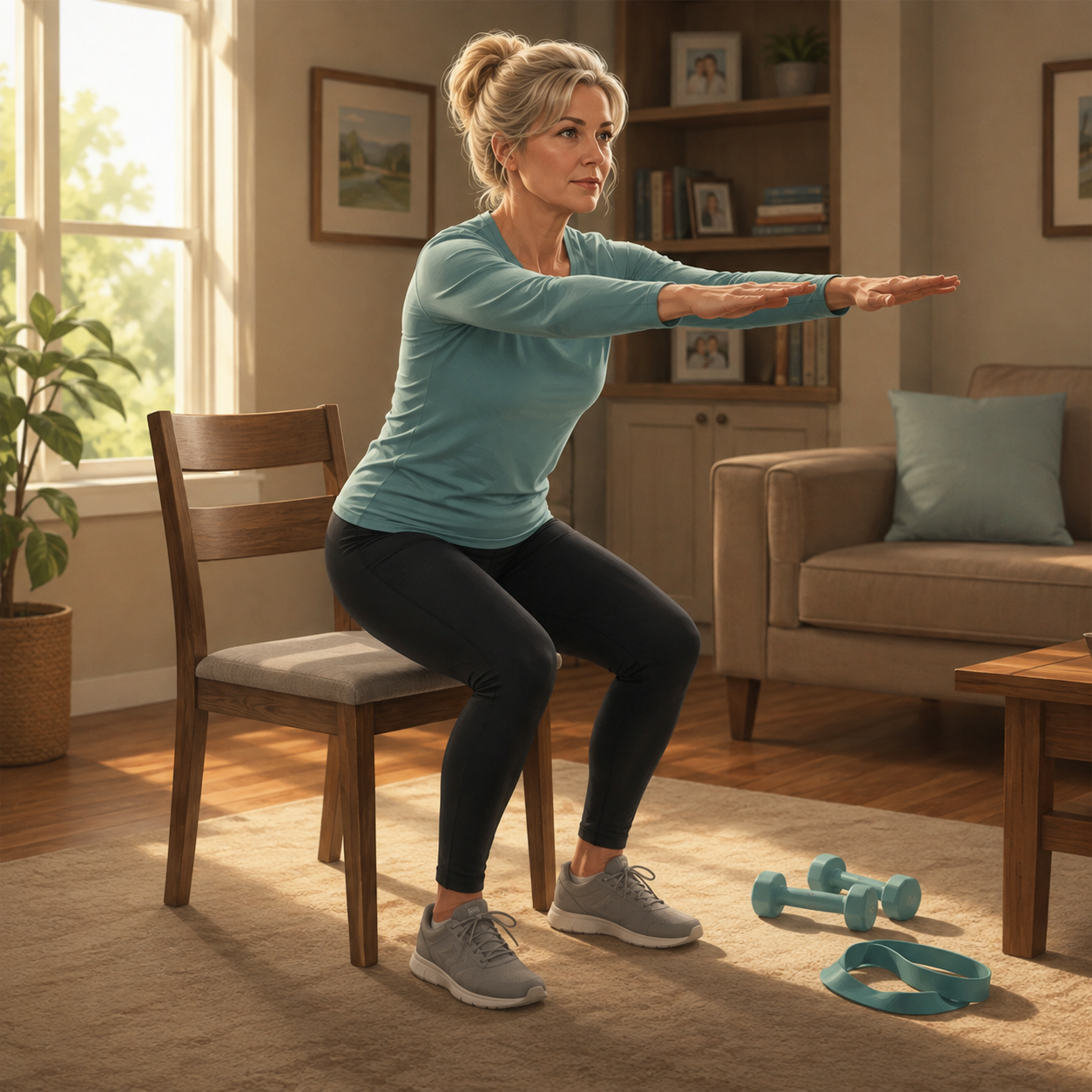
- Begin with bodyweight and bands. Sit-to-stands from a chair, wall sits, heel raises and band-resisted movements let you find your tolerance without committing to a load. A set like the Fit Simplify Resistance Loop Exercise Bands gives you five resistance levels, which matters because your usable load will vary week to week.
- Prioritise the muscles around the affected joint. For knees, that means quadriceps above all, plus glutes and calves. For hips, glutes. For hands, grip and finger work. But train the whole body — the rest of you shouldn't decondition while you rehabilitate one joint.
- Use range you can control. A partial-range squat done well beats a full-depth one that hurts. Range often expands on its own as strength improves; forcing it rarely helps.
- Progress the load, not just the reps. Once you can do 12–15 controlled reps with two or three left in reserve, add a little weight. An adjustable step platform such as The Step Original Aerobic Platform is genuinely useful here because you can raise step-up height in small increments rather than jumping from a low step to a full stair.
- Add external weight when bodyweight stops challenging you. A pair of adjustable dumbbells like the Bowflex SelectTech 552 lets you move in 2.5lb steps, which suits the small, patient increases this needs far better than a jump between fixed dumbbells.
If you're unsure where to begin, or you have significant existing joint damage, a few sessions with a physiotherapist to set the starting point is a genuinely good investment — and one of the RAPIT trial's features was that the exercise was supervised. If your knee pain isn't from diagnosed arthritis, our guide to the common causes of knee pain during workouts may be a better starting point.
What about flares, and different types of arthritis?
Osteoarthritis and inflammatory arthritis such as rheumatoid arthritis behave differently, and the exercise advice differs accordingly. In osteoarthritis, symptoms tend to track loading and settle with sensible management. In inflammatory arthritis, flares are driven by immune activity and can arrive independently of anything you did in the gym — which means blaming yourself for a flare is usually both wrong and unhelpful.
During an active flare, the general principle is to reduce rather than stop. Keep the joints moving through their range, drop the weight substantially, shorten sessions, and train the areas that aren't affected. Complete rest costs strength that then takes weeks to rebuild, which is precisely the spiral you're trying to avoid. Your rheumatology team is the right place to agree a flare plan in advance.
A few situations warrant a conversation with a clinician before you train: a joint that is hot, red and swollen; a recent joint replacement, where surgical protocols take precedence; or any sudden change in your usual pattern of pain.
Why tracking matters more here than anywhere else
Because the improvements are slow and the setbacks are memorable. Arthritis pain fluctuates with weather, sleep, stress and disease activity, so a single bad session tells you almost nothing — and yet a bad session is exactly the thing that ends training programmes.
Logging what you lifted, how the joint felt during, and how it felt the next morning converts that noise into a signal. Over eight weeks you can see whether your working weight is climbing while your next-day soreness stays flat, which is the pattern you're after. That's the kind of slow, multi-variable trend Health Mentor AI is built to surface — connecting your training load to your pain, sleep and energy over months rather than leaving you to remember it.
One reframe to carry with you: you are not choosing between loading the joint and protecting it. Loading it, gradually and deliberately, is how you protect it. And since the same lever also builds the muscle you'll rely on decades from now, it's worth reading alongside why protein is the one macro that decides how you age — muscle needs both the stimulus and the material.
Frequently Asked Questions
Does strength training make arthritis worse?
The evidence does not support that fear. In a two-year randomised trial of high-intensity exercise in people with rheumatoid arthritis, intensive training did not increase X-ray joint damage in the large joints and was linked to less damage in the hands and feet than usual-care physiotherapy. Exercise guidance is now standard in osteoarthritis care.
How much pain during exercise is acceptable with arthritis?
A widely used clinical rule of thumb is that discomfort up to around 5 out of 10 during exercise is acceptable, provided it settles back to your normal baseline within about 24 hours and does not build across sessions. Sharp, sudden or joint-locking pain is different and should be assessed.
What is the best strength exercise for knee arthritis?
There is no single best exercise, but quadriceps strengthening has the most evidence behind it because the quadriceps stabilise and absorb load through the knee. Sit-to-stands, controlled leg press, step-ups and leg extensions all work. Consistency over months matters far more than exercise selection.
Should you exercise during an arthritis flare?
During an active inflammatory flare, most guidance is to reduce load rather than stop entirely. Keep joints moving through their range, drop the weight substantially, and train unaffected areas. Stopping completely tends to cost strength that then takes weeks to rebuild. Discuss flare management with your rheumatology team.
Scientific References
- de Jong et al. (2003), Arthritis & Rheumatism — Is a long-term high-intensity exercise program effective and safe in patients with rheumatoid arthritis? (the RAPIT trial)
- de Jong et al. (2004), Annals of the Rheumatic Diseases — Long term high intensity exercise and damage of small joints in rheumatoid arthritis
- Slemenda et al. (1997), Annals of Internal Medicine — Quadriceps weakness and osteoarthritis of the knee
- Segal & Glass, Current Reviews in Musculoskeletal Medicine — Is quadriceps muscle weakness a risk factor for incident or progressive knee osteoarthritis?
- Lawford et al. (2024), Cochrane Database of Systematic Reviews — Exercise for osteoarthritis of the knee (139 trials, 12,468 participants)
- Strength training vs. aerobic training for managing pain and physical function in patients with knee osteoarthritis: a systematic review and meta-analysis
Products Mentioned in This Article
These products were referenced throughout the article to support starting and progressing resistance training with arthritis.
Fit Simplify Resistance Loop Exercise Bands (Set of 5)
Five resistance levels in one inexpensive set — useful precisely because your tolerable load will vary from week to week with arthritis. Light enough to start below your threshold, with somewhere to progress to.
View on Amazon →The Step Original Aerobic Platform with Risers
Adjustable in 2-inch increments from 4 to 8 inches, which lets you progress step-ups gradually rather than jumping straight to a full stair. Also useful for setting sit-to-stand height as you build quadriceps strength.
View on Amazon →Bowflex SelectTech 552 Adjustable Dumbbells
Adjust from 5 to 52.5lb, in 2.5lb increments through the lower range — which is exactly the fine-grained progression that arthritic joints tolerate best. A significant purchase, but it replaces fifteen pairs of dumbbells for home training.
View on Amazon →As an Amazon Associate, we earn from qualifying purchases. This comes at no additional cost to you.