
Before you read on: this is general education, not personal medical advice. Diabetes management is highly individual and depends on your medications, other conditions and how your body responds. Talk to your GP, diabetes nurse or consultant before making significant changes to your activity, and never adjust medication doses on your own.
You finish a hard gym session, check your glucose expecting a reward for the effort, and the number has gone up. Meanwhile a gentle walk round the block after dinner, which felt like nothing at all, drops it noticeably. If you've had that experience and concluded your body is broken or the meter is wrong, neither is true — you've just run into one of the more counterintuitive parts of exercise physiology.
Exercise is one of the most powerful tools available for managing type 2 diabetes. But it isn't a single lever with a single direction, and understanding why different sessions do different things makes the whole thing far less frustrating to manage.
Why exercise lowers blood sugar even when insulin isn't working well
Contracting muscle can take up glucose through a mechanism that operates independently of insulin — and this is the single most useful thing to understand about exercise and type 2 diabetes.
Normally, glucose gets into muscle cells because insulin signals transporters to move to the cell surface. In insulin resistance, that signal is heard poorly, so glucose lingers in the bloodstream. But muscle contraction itself recruits those same transporters through a separate pathway. The muscle effectively opens the door itself, without waiting for the insulin signal.
This is why walking works for people whose insulin signalling is substantially impaired, and why the effect appears from the very first session rather than requiring weeks of adaptation. On top of that acute effect, regular training improves insulin sensitivity over the following days, so the benefits stack.
Key insight: Your muscles are the largest place glucose can go. Training makes that destination both bigger and more willing to accept deliveries — which is why resistance training matters here as much as cardio.
Why hard sessions can push glucose the other way
Very intense or competitive exercise triggers a stress response — adrenaline, and later cortisol — that tells the liver to release stored glucose into the bloodstream. If that release outpaces what working muscle is taking up, your reading rises.
This is a normal physiological response, not a malfunction. It's also usually temporary: levels typically come down over the following hours, and the longer-term improvement in insulin sensitivity from the session still happens. Anxiety before an event, competition, heat and illness can all amplify it.
⬇️ Usually lowers glucose
Steady walking, easy cycling, swimming, gardening, moderate resistance training. Muscle uptake dominates. The effect is greatest when there's glucose in circulation to take up — i.e. after eating.
⬆️ May raise it temporarily
Sprints, heavy near-maximal lifting, competitive matches, anything with a big adrenaline component. Liver output outpaces uptake. Usually settles within a few hours.
The practical upshot isn't to avoid hard training — it has real benefits. It's to expect the pattern, so a post-session spike doesn't send you into a spiral of thinking the exercise made things worse.
The timing that punches above its weight
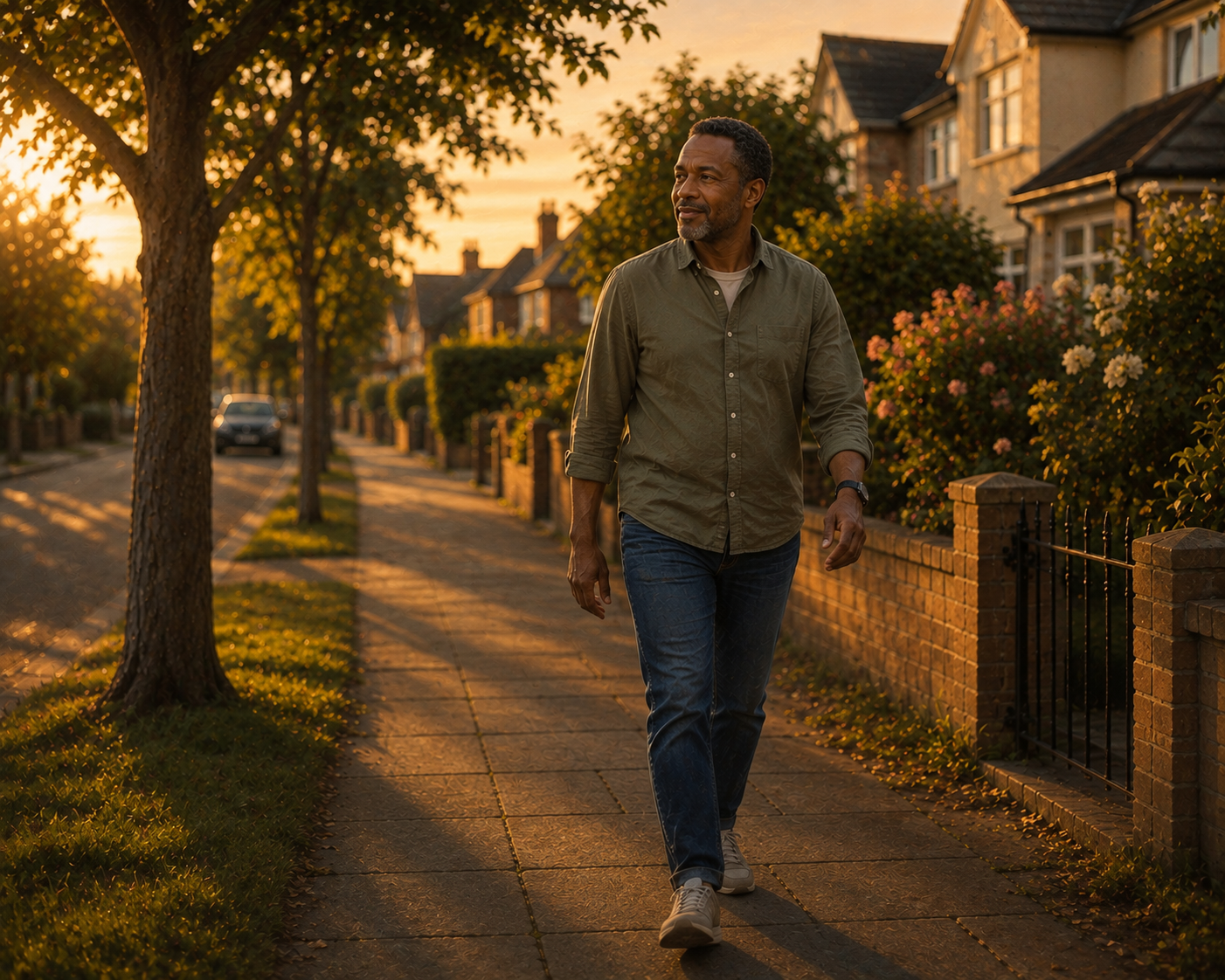
Walking after meals is dramatically more effective than the same amount of walking done at an arbitrary time, and it's the highest-return change most people can make.
A randomised crossover study in people with type 2 diabetes, published in Diabetologia, compared advice to walk 30 minutes a day at any time with advice to walk 10 minutes after each of the three main meals. Post-meal blood glucose was around 12% lower on average with the post-meal timing — with the same total walking time. The largest share of that came from a roughly 22% improvement in the three hours after the evening meal, when carbohydrate intake was highest and people were otherwise most sedentary.
Same effort, different result, purely because of when it happened. If you take one thing from this article, a short walk after dinner is probably it.
What kind of training, and how much
The evidence favours doing both cardio and strength work rather than picking one — combined training outperformed either type alone in the trial designed specifically to answer that question.
The DARE trial randomised 251 adults with type 2 diabetes to aerobic training, resistance training, or both, and published results in Annals of Internal Medicine. Each modality alone improved HbA1c — roughly 0.5 and 0.4 percentage points for aerobic and resistance training respectively — and combined training produced the largest improvement of the three groups.
Alongside structured sessions, the American Diabetes Association's position statement in Diabetes Care emphasises breaking up prolonged sitting with brief activity roughly every 30 minutes, on top of longer exercise sessions. That's a separate lever from your workout, and for anyone with a desk job it may matter as much — we went into the mechanism in the desk-bound athlete.
Hypoglycaemia: who's actually at risk
The risk of low blood sugar during or after exercise depends far more on your medication than on the exercise itself, and this distinction is often blurred in general advice.
If you're managing type 2 diabetes with lifestyle alone or with metformin, the risk of exercise-induced hypoglycaemia is low. If you take insulin or a sulfonylurea (gliclazide, glipizide, glimepiride and similar), the risk is meaningfully higher, and it doesn't end when the session does — glucose uptake can stay elevated for hours afterwards, so a late-evening session can affect you overnight.
That's a conversation to have with your diabetes team before you significantly increase activity, not after a bad episode. They can advise on whether your doses or timing need adjusting — which is their call, not something to work out from an article.
⚠️ Know the signs of a hypo
- Early signsShakiness, sweating, sudden hunger, pounding heart — easy to mistake for exercise itself
- Later signsConfusion, blurred vision, difficulty concentrating, irritability — treat immediately
- If it happensStop, sit down, take fast-acting glucose — roughly 15g, then recheck after 15 minutes
- ThenFollow up with a longer-acting snack — and tell your diabetes team it happened
- NeverExercise alone if you're prone to hypos — tell someone where you are and what to do
Carry fast-acting glucose whenever you train if you're on insulin or a sulfonylurea. Pre-measured tablets like TRUEplus Glucose Tablets are easier than guessing with sweets because the dose is known and they don't melt in a gym bag. Your team will tell you the amount that's right for you.
Building it into a week that actually happens
The programme that works is the one that fits around meals and your existing day, rather than the one that requires a new identity.
- Anchor walks to meals. Ten to fifteen minutes after eating, three times a day. It's the single most evidence-backed timing change available, and it doesn't require a gym, kit or a shower afterwards.
- Add two resistance sessions. Muscle is where glucose goes, so building more of it improves your capacity to handle it. Bands like the Fit Simplify Resistance Loop Bands are a low-intimidation start if a gym isn't realistic yet.
- Break up sitting. A couple of minutes of movement every half hour. An under-desk unit such as the Sperax Walking Pad makes this trivial if you work from home, though the stairs and the kettle work fine too.
- Introduce hard sessions gradually. They're valuable, but expect the glucose response to be less predictable at first, and get medical clearance before starting vigorous exercise if you've been inactive.
- Look after your feet. Check them daily for blisters, redness or breaks in the skin, and wear properly fitting shoes. Reduced sensation means an injury can go unnoticed until it's serious — this is not a minor footnote.
A few situations need individual medical guidance before you start or intensify: proliferative retinopathy or recent eye treatment, where certain vigorous activities may not be advised; peripheral neuropathy, where foot care and activity choice matter more; kidney disease; autonomic neuropathy; known cardiovascular disease; or any symptoms like chest discomfort, unusual breathlessness or dizziness on exertion. None of these mean you can't exercise — they mean the plan should be built with your clinician.
Learning your own patterns
Your glucose response to a given session is more individual than any general guidance can capture, which makes your own data the most valuable thing you have. Two people with the same diagnosis and similar medication can respond quite differently to identical exercise.
What's worth noting alongside a reading: what you did, how hard it was, how long it lasted, when you last ate and what, and the time of day. After a few weeks, patterns emerge — that morning sessions before breakfast behave differently to evening ones, or that a particular class reliably spikes you, or that the after-dinner walk is doing more than the gym.
That's the kind of multi-variable pattern Health Mentor AI is designed to hold onto — logging food, activity, sleep and how you felt in one place so the relationships become visible over months rather than being reconstructed from memory in a ten-minute appointment. Bring what you find to your diabetes team; it makes those appointments considerably more productive.
One last reframe. It's easy to treat every glucose reading as a verdict on whether you're doing well or badly. It isn't. Readings are information about how your body responded to a specific set of circumstances, and some of those circumstances — stress, illness, sleep, hormones — have nothing to do with your effort. What matters is the direction over months, not the number after one workout. And the direction responds remarkably well to a short walk after dinner and a couple of sessions with some weights.
Frequently Asked Questions
Why does my blood sugar go up after exercise?
Very hard or highly competitive exercise triggers stress hormones such as adrenaline, which prompt the liver to release stored glucose faster than working muscle can take it up. The result can be a temporary rise. It usually settles afterwards, and the longer-term effect on insulin sensitivity is still beneficial. Discuss any persistent pattern with your diabetes team.
When is the best time to walk to lower blood sugar?
After meals. In a randomised crossover study in people with type 2 diabetes, advice to walk for 10 minutes after each main meal lowered post-meal blood glucose by about 12 percent on average compared with 30 minutes of walking at any time of day, with the largest benefit after the evening meal.
What type of exercise is best for type 2 diabetes?
A combination. In a randomised trial of 251 adults with type 2 diabetes, aerobic training and resistance training each improved HbA1c, but combined training produced the greatest improvement of the three. Practically, that means both cardio and strength work rather than choosing between them.
Can exercise cause low blood sugar in type 2 diabetes?
It can, but the risk depends heavily on your medication. People taking insulin or sulfonylureas face a meaningfully higher risk of hypoglycaemia during or after exercise than those on metformin alone. If you take either, agree a plan with your diabetes team before increasing activity, and carry fast-acting glucose.
Scientific References
- Colberg et al. (2016), Diabetes Care — Physical activity/exercise and diabetes: a position statement of the American Diabetes Association
- Reynolds et al. (2016), Diabetologia — Advice to walk after meals is more effective for lowering postprandial glycaemia in type 2 diabetes mellitus than advice that does not specify timing: a randomised crossover study
- Sigal et al. (2007), Annals of Internal Medicine — Effects of aerobic training, resistance training, or both on glycemic control in type 2 diabetes: a randomized trial
- Church et al. (2010), JAMA — Effects of aerobic and resistance training on hemoglobin A1c levels in patients with type 2 diabetes: a randomized controlled trial
Products Mentioned in This Article
These products were referenced throughout the article. None of them replace advice from your diabetes team.
TRUEplus Glucose Tablets
Pre-measured fast-acting glucose in a form that survives a gym bag, so treating a low doesn't involve guesswork about how much you've taken. Relevant mainly if you take insulin or a sulfonylurea — your team will confirm the right amount for you.
View on Amazon →Fit Simplify Resistance Loop Exercise Bands (Set of 5)
An inexpensive way to start resistance training at home, with five levels to progress through. Given that combined training beat cardio alone in the DARE trial, adding some strength work is one of the higher-value changes available.
View on Amazon →Sperax Walking Pad / Under-Desk Treadmill
Makes short, frequent walking possible regardless of weather or daylight — useful for both the after-meal walk and for breaking up long sedentary stretches. Optional: stairs, a hallway and a set alarm achieve the same thing for free.
View on Amazon →As an Amazon Associate, we earn from qualifying purchases. This comes at no additional cost to you.